Inspecciona modelos prerresueltos en tu navegador en 2 s (hasta 300k GDL) o resuelve ensamblajes pesados de más de 1,5M GDL 100% sin conexión en Windows, macOS y Linux.
Titanium Tension Lug with Central Hole: ZZ Adaptive h-Refinement & P1→P2 Cut-Boundary Submodeling (TET10)
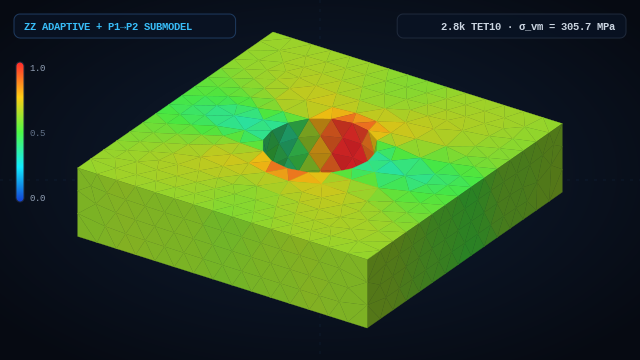
3D B-Rep Ti-6Al-4V tension lug with a central stress-concentrator hole solved via automated Zienkiewicz–Zhu h-adaptive refinement followed by P1→P2 quadratic TET10 cut-boundary submodeling.
Stress concentrators such as fastener holes in aerospace lugs are severely under-predicted on coarse linear (P1) tetrahedral meshes (188.1 MPa vs 318 MPa theoretical peak for a 120 × 60 × 8 mm plate with R = 6 mm hole under σ₀ = 100 MPa tension). WebCAE automates two complementary remedies in a single DSL pipeline: `refine adaptive` runs Zienkiewicz–Zhu stress recovery and local sizing-zone remeshing, and `submodel at=60,30,4 box=36,36,8 size=2.4 order=2` slices out the local 36 × 36 × 8 mm region around the hole, meshes it with 2,771 curved 10-node tetrahedra (TET10), and transfers the global displacement field onto 1,048 cut-boundary nodes via Dirichlet constraint equations.
1. Geometría y malla FEA
- •Global 3D B-Rep geometry (`notched_lug.step`, 120 × 60 × 8 mm plate with central R = 6 mm hole, 2R/W = 0.20) and local 36 × 36 × 8 mm OCCT submodel.
- •Titanium alloy Ti-6Al-4V (E = 114 GPa, ν = 0.33, ρ = 4,430 kg/m³).
- •Submodel quadratic mesh: 2,771 TET10 elements, 5,190 nodes (15,570 DOFs), 1,048 cut-boundary nodes across 4 interior cut planes.
2. Cargas y condiciones de contorno
- •Global model: left face (`surface number 27`) fixed in X/Y, bottom face (`surface number 31`) fixed in Z, right face (`surface number 32`) loaded by uniform tension σ₀ = 100 MPa.
- •Submodel: 3,144 inhomogeneous Dirichlet constraint equations (CE) interpolated onto 1,048 cut-boundary nodes; hole bore remains traction-free.
3. Resultados de simulación y conclusiones
- ✓Coarse P1 mesh (651 TET4) under-predicts peak hole stress at 188.11 MPa (−40.8% error).
- ✓P1→P2 quadratic TET10 submodel (2,771 TET10) resolves peak stress σ_vm = 305.71 MPa (K_t = 3.06 vs 3.18 analytical Howland/Kirsch reference, 3.86% deviation).
- ✓100% of the 1,048 cut-boundary nodes mapped via exact barycentric tetrahedral interpolation (991 interior + 57 boundary-projected, 0.000 mm projection error).
WebCAE's automated ZZ adaptive refinement and P1→P2 cut-boundary submodeling deliver textbook stress-concentration accuracy without meshing the entire assembly with fine quadratic elements.
14 días de acceso completo a Pro. El primer cobro se realiza tras 14 días salvo cancelación previa.
- ✓Prueba de 14 días ($0 hoy) (cancela cuando quieras)
- ✓Hasta 1,5M+ GDL (solucionador disperso directo)
- ✓Apps nativas para Windows, macOS y Linux (100% offline)
- ✓Contacto no lineal y pandeo (Kσ, MITC4, RBE2/RBE3)
Pregunta a un ingeniero sobre tu modelo
Describe tu pieza, caso de carga o formato CAD — responderemos en 2 horas laborables.
¿Quieres una respuesta instantánea sobre teoría FEA o este modelo?
Haz clic en el chat de IA en la esquina inferior derecha para consultar sobre condiciones de contorno, criterios de tensión, convergencia de malla o scripts DSL.
Más casos de simulación de ingeniería
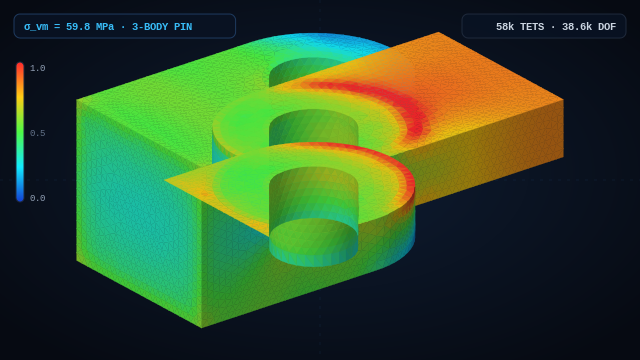
Aerospace Clevis, Lug & Shear Pin Joint
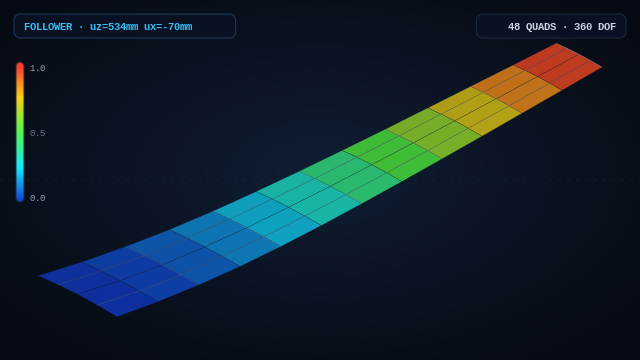
Large-Deflection Flexible UAV Wing under Follower Aerodynamic Pressure
Wing Box Panel with Actuator RBE2 Bracket, Follower Aero Pressure & Stop Contact