Inspecciona modelos prerresueltos en tu navegador en 2 s (hasta 300k GDL) o resuelve ensamblajes pesados de más de 1,5M GDL 100% sin conexión en Windows, macOS y Linux.
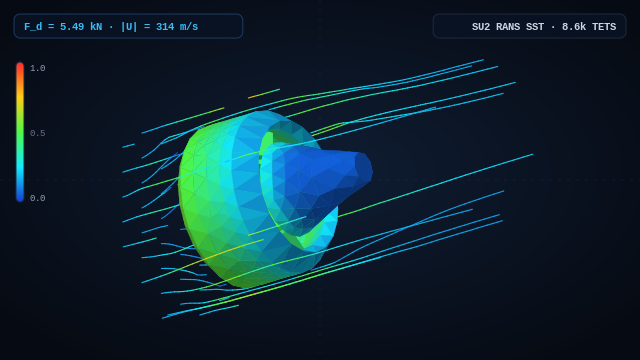
Annular Aerospike Plug Nozzle with Truncated Central Body & 6 Cooling Pylons (CFD)
3D turbulent flow (RANS k-ω SST, U_in = 50 m/s) through an annular aerospike rocket nozzle with a profiled cowling shroud lip, 6 pitched regenerative-cooling pylon struts (12°), a contoured central plug ramp, and a Ø32 mm truncated plug base generating a recirculating base wake vortex.
Unlike conventional bell nozzles that are fixed to a single expansion ratio, an annular aerospike (plug) nozzle expands exhaust gas along an external contoured central spike bounded by the ambient slipstream, automatically adapting its effective plume boundary from sea level to vacuum. In practical flight weight designs (such as the XRS-2200 and toroidal aerospike demonstrators), the sharp spike tip is truncated at 20–30% of its full length; the resulting flat base traps a recirculating subsonic vortex bubble ('aerodynamic plug') that pressurizes the base face and recovers thrust. This 3D CFD model embeds a complete annular aerospike assembly inside a Ø210 × 420 mm cylindrical test cell: a central plug body (Ø100 mm throat shoulder tapering along a two-stage expansion ramp to a Ø32 mm truncated base), an outer combustor cowling shroud (Ø128 mm throat lip, 14 mm annular throat gap), and 6 hexagonal cooling struts pitched at 12°. Solved with native SU2_CFD (k-ω SST) at U_in = 50 m/s, the flow accelerates through the annular throat to |U|_max = 313.96 m/s (6.28× inlet speed), generating F_X = 5,490.4 N of axial aerodynamic force, Δp = 490.0 kPa pressure drop, and a coherent toroidal base wake vortex (Q_max = 3.53×10⁷ s⁻²).
1. Geometría y malla FEA
- •Single B-Rep fluid control volume (52 topological faces, V = 13.03×10⁶ mm³): cylindrical test cell X ∈ [−130, 290] mm, outer radius R = 105 mm (Ø210 mm).
- •Contoured central aerospike plug (X ∈ [−85, 135] mm): nose cone, Ø84 mm hub, Ø100 mm throat shoulder at X = 40 mm, two-stage expansion ramp, and Ø32 mm flat truncated base.
- •Revolved annular combustor cowling shroud (X ∈ [−45, 52] mm, throat lip R = 64 mm creating a 14 mm annular throat gap) linked to the central plug by 6 pitched struts (chord 44 mm, thickness 10 mm, pitch 12°, 60° spacing).
- •Unstructured 3D tetrahedral mesh: 8,627 tetrahedra and 2,448 nodes (volume discretization error 0.39%).
2. Cargas y condiciones de contorno
- •Upstream test-cell inlet face at X = −130 mm (surface number 3): uniform velocity inlet U_in = 50.0 m/s along +X ([1, 0, 0]).
- •Downstream plume exit face at X = +290 mm (surface number 2): static gauge pressure p_out = 0 Pa.
- •Outer cylindrical boundary at R = 105 mm (surface number 1): slip / symmetry boundary condition.
- •All 49 internal wet faces of the central aerospike plug, truncated base, cowling shroud, and 6 struts (surfaces 4–52): viscous no-slip wall with force monitoring (monitor=on).
3. Resultados de simulación y conclusiones
- ✓Annular throat constriction and contoured plug expansion accelerate the airstream from 50 m/s up to |U|_max = 313.96 m/s (6.28× inlet velocity).
- ✓Integrated axial aerodynamic force on the aerospike plug, shroud, and 6 struts is F_X = 5,490.45 N (5.49 kN) with a static pressure drop of Δp = 490.04 kPa (peak upstream stagnation +495.7 kPa, base/throat suction −5.26 kPa).
- ✓Strong shear-layer roll-up along the plug ramp and recirculating base wake behind the Ø32 mm truncated plug reach |ω|_max = 17,893.6 s⁻¹ and Q_max = 3.53×10⁷ s⁻² (mass balance error 2.35%).
Aerospace propulsion teams use WebCAE to analyze plug nozzle truncation percentages, pylon wake disturbances, annular throat discharge coefficients, and base pressure recovery directly from 3D CAD assemblies.
14 días de acceso completo a Pro. El primer cobro se realiza tras 14 días salvo cancelación previa.
- ✓Prueba de 14 días ($0 hoy) (cancela cuando quieras)
- ✓Hasta 1,5M+ GDL (solucionador disperso directo)
- ✓Apps nativas para Windows, macOS y Linux (100% offline)
- ✓Contacto no lineal y pandeo (Kσ, MITC4, RBE2/RBE3)
Pregunta a un ingeniero sobre tu modelo
Describe tu pieza, caso de carga o formato CAD — responderemos en 2 horas laborables.
¿Quieres una respuesta instantánea sobre teoría FEA o este modelo?
Haz clic en el chat de IA en la esquina inferior derecha para consultar sobre condiciones de contorno, criterios de tensión, convergencia de malla o scripts DSL.
Más casos de simulación de ingeniería
Aerospace Clevis, Lug & Shear Pin Joint
Large-Deflection Flexible UAV Wing under Follower Aerodynamic Pressure
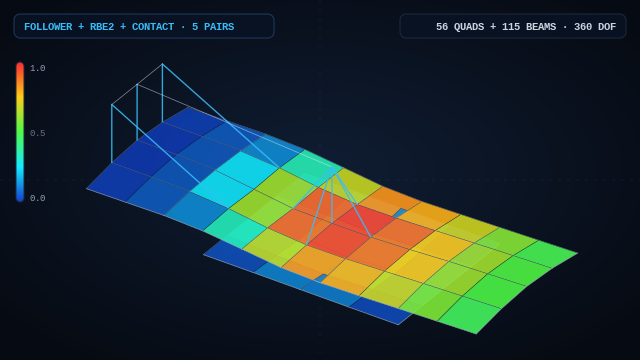
Wing Box Panel with Actuator RBE2 Bracket, Follower Aero Pressure & Stop Contact