Inspecciona modelos prerresueltos en tu navegador en 2 s (hasta 300k GDL) o resuelve ensamblajes pesados de más de 1,5M GDL 100% sin conexión en Windows, macOS y Linux.
Liquid Rocket Engine (LRE) Coaxial Swirl Injector Head, Flameholder & De Laval Nozzle (CFD)
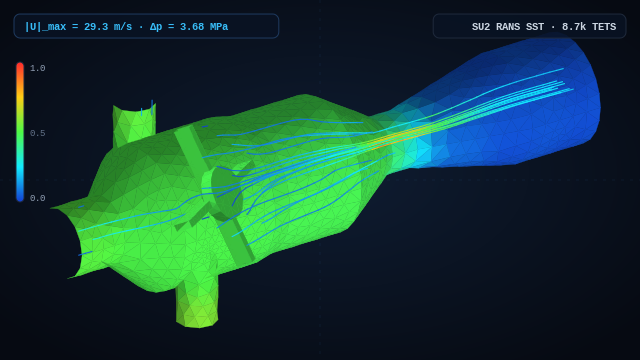
3D turbulent internal flow (RANS k-ω SST, RP-1 propellant simulant) in a liquid rocket engine chamber with axial oxidizer feed (8 m/s), dual tangential fuel swirl injectors (12 m/s), a 4-strut conical flameholder bluff body, and a converging-diverging De Laval nozzle (contraction ratio 6.25×), accelerating the core jet to 29.31 m/s.
Liquid rocket engine (LRE) thrust chambers and preburners rely on coaxial and tangential swirl injectors to atomize and rapidly mix propellant streams while forming a protective cool peripheral film along the chamber wall. Downstream of the injector face, bluff-body flameholders and mixer struts anchor recirculation zones before the flow undergoes strong area contraction (6.25×) through the critical throat of a De Laval converging-diverging nozzle. This 3D CFD model represents the complete internal fluid core (410 mm length, Ø100 mm cylindrical chamber, Ø40 mm nozzle throat, Ø76 mm exit bell) fed by an axial Ø48 mm oxidizer manifold at 8.0 m/s and two opposed tangential Ø28 mm fuel channels at 12.0 m/s. Solved in native SU2_CFD (Menter k-ω SST with multigrid acceleration), the simulation resolves peripheral swirl film generation, wake shear layers behind the 45°-clocked 4-strut flameholder (F_D = 158.55 N), nozzle throat acceleration up to |U|_max = 29.31 m/s (3.06× effective inlet speed), a chamber-to-exit pressure drop of Δp = 3.68 MPa, and multi-inlet mass conservation within 0.62%.
1. Geometría y malla FEA
- •Single connected B-Rep fluid volume (34 topological faces, V = 1.954×10⁶ mm³): axial inlet at X = −90 mm (Ø48 mm), cylindrical chamber X ∈ [−30, 120] mm (Ø100 mm), converging nozzle X ∈ [120, 165] mm, critical throat X ∈ [165, 185] mm (Ø40 mm, area contraction ratio 6.25×), and diverging bell X ∈ [185, 320] mm (Ø76 mm).
- •Two tangential fuel injection pipes (Ø28 mm at X = −5 mm, Y = ±35 mm, Z = ∓65 mm) injecting co-rotating angular momentum around the +X chamber axis.
- •Internal conical-cylindrical flameholder bluff body (Ø36 mm base at X = 45 mm) supported by 4 diagonal 45° mixer struts.
- •Unstructured 3D tetrahedral mesh generated by Netgen: 8,672 tetrahedra and 2,297 nodes (volume error 1.00%); working fluid: RP-1 kerosene (ρ = 800 kg/m³, μ = 1.6×10⁻³ Pa·s).
2. Cargas y condiciones de contorno
- •Axial oxidizer inlet face at X = −90 mm (surface number 28): normal velocity U_ox = 8.0 m/s, turbulence intensity 5%.
- •Two tangential fuel injector inlet faces at Z = ∓65 mm (surfaces 2 and 27): normal velocity U_fuel = 12.0 m/s, turbulence intensity 5%.
- •Nozzle exit plane at X = +320 mm (surface number 34): static gauge pressure p_out = 0 Pa.
- •Internal flameholder cone, base, and 4 diagonal struts (19 faces): viscous no-slip wall with active aerodynamic force monitoring (monitor=on); outer chamber and nozzle walls: viscous no-slip wall.
3. Resultados de simulación y conclusiones
- ✓Total mass flow rate from the axial oxidizer inlet and dual tangential fuel injectors is m_in = 12.042 kg/s, matching the nozzle exit mass flow m_out = 11.968 kg/s within 0.62%.
- ✓Flow accelerates through the converging nozzle into the Ø40 mm critical throat up to |U|_max = 29.31 m/s (3.06× the area-weighted inlet speed of 9.57 m/s) with a total chamber-to-exit pressure drop of Δp = 3.68 MPa.
- ✓The swirling core and 4-strut flameholder generate an axial hydrodynamic drag force of F_D = 158.55 N (C_D = 2.628) and intense helical shear layers with |ω|_max = 2,161.9 s⁻¹ and Q_max = 2.18×10⁵ s⁻².
Propulsion engineers use WebCAE CFD to evaluate swirl injector momentum ratios, flameholder pressure losses, wall film cooling coverage, and converging-diverging nozzle flow uniformity directly on parametric 3D B-Rep chamber geometries.
14 días de acceso completo a Pro. El primer cobro se realiza tras 14 días salvo cancelación previa.
- ✓Prueba de 14 días ($0 hoy) (cancela cuando quieras)
- ✓Hasta 1,5M+ GDL (solucionador disperso directo)
- ✓Apps nativas para Windows, macOS y Linux (100% offline)
- ✓Contacto no lineal y pandeo (Kσ, MITC4, RBE2/RBE3)
Pregunta a un ingeniero sobre tu modelo
Describe tu pieza, caso de carga o formato CAD — responderemos en 2 horas laborables.
¿Quieres una respuesta instantánea sobre teoría FEA o este modelo?
Haz clic en el chat de IA en la esquina inferior derecha para consultar sobre condiciones de contorno, criterios de tensión, convergencia de malla o scripts DSL.
Más casos de simulación de ingeniería
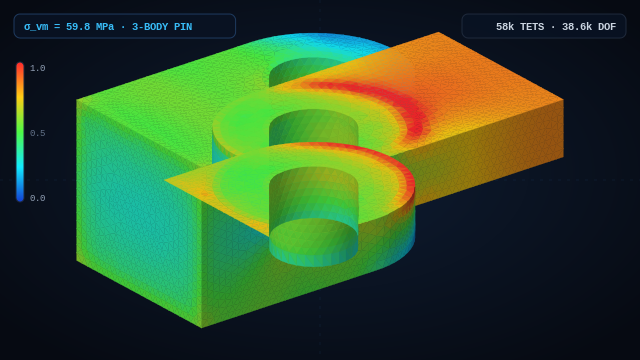
Aerospace Clevis, Lug & Shear Pin Joint
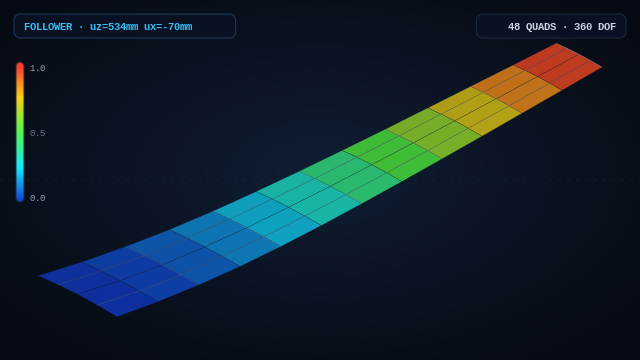
Large-Deflection Flexible UAV Wing under Follower Aerodynamic Pressure
Wing Box Panel with Actuator RBE2 Bracket, Follower Aero Pressure & Stop Contact