Inspecciona modelos prerresueltos en tu navegador en 2 s (hasta 300k GDL) o resuelve ensamblajes pesados de más de 1,5M GDL 100% sin conexión en Windows, macOS y Linux.
Double Cantilever Beam (DCB): Bilinear Cohesive Zone (CZM) Delamination & Mode I Crack Peeling
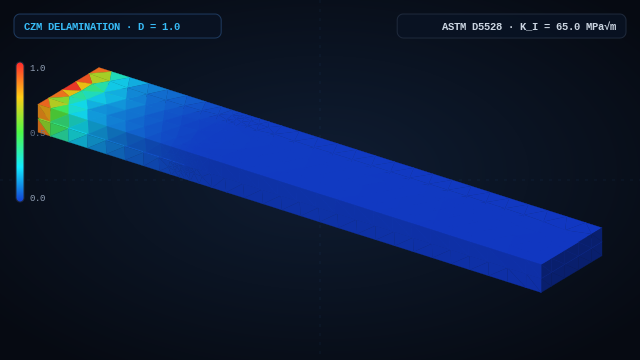
Standard ASTM D5528 Double Cantilever Beam composite/adhesive peel test modeled via bilinear traction-separation cohesive zone elements (CZM) with progressive stiffness degradation and Mode I stress intensity evaluation.
Composite laminates and bonded aerospace joints are susceptible to interlaminar delamination under peel forces. The ASTM D5528 Double Cantilever Beam (DCB) test is the industry standard for determining Mode I interlaminar fracture toughness G_Ic. This model simulates two 3 mm adherend arms (length 120 mm, width 20 mm) with a 35 mm initial non-adhesive pre-crack. Under opposing ±150 N tip forces, WebCAE's bilinear cohesive contact interface tracks damage accumulation from pristine contact (D = 0) to complete debonding (D = 1.0).
1. Geometría y malla FEA
- •3D B-Rep multi-body assembly (`dcb_upper_arm.step` and `dcb_lower_arm.step`, 120 × 20 × 6 mm total).
- •1,583 TET4 elements across both cantilever arms, 658 nodes.
- •Adherend material: E = 70 GPa, ν = 0.33, ρ = 2,700 kg/m³; Cohesive interface: normal stiffness K_n = 100 GPa/m, tangential stiffness K_t = 50 GPa/m, peak normal traction t_n = 30 MPa, fracture energy G_Ic = 450 J/m².
2. Cargas y condiciones de contorno
- •Cantilever root faces rigidly fixed (`fix surface number 28 and surface number 60`, x = 120 mm).
- •Opposing vertical peel forces applied at the free arm tips (`F_z = +150 N` on upper arm, `F_z = -150 N` on lower arm at x = 0 mm).
- •Cohesive contact bonded between interface faces (`contact cohesive master="surface number 64" slave="surface number 33"`) with crack front monitoring at `edge number 48`.
3. Resultados de simulación y conclusiones
- ✓Full crack opening of 2 u_z = 1.36 mm achieved at the loading pins, with maximum tip displacement |u|_max = 0.68 mm per arm.
- ✓Crack-front edge elements reach full CZM damage D = 1.0 with a peak normal opening displacement of 0.282 mm.
- ✓Mode I stress intensity factor reaches K_I = 64.99 MPa√m with path-independent J-integral of 53.77 kJ/m² and peak arm bending stress of 175.0 MPa.
WebCAE's cohesive zone modeling (CZM) enables aerospace composites engineers to predict adhesive joint delamination growth, peel failure envelopes, and peel arrest without empirical safety margins.
14 días de acceso completo a Pro. El primer cobro se realiza tras 14 días salvo cancelación previa.
- ✓Prueba de 14 días ($0 hoy) (cancela cuando quieras)
- ✓Hasta 1,5M+ GDL (solucionador disperso directo)
- ✓Apps nativas para Windows, macOS y Linux (100% offline)
- ✓Contacto no lineal y pandeo (Kσ, MITC4, RBE2/RBE3)
Pregunta a un ingeniero sobre tu modelo
Describe tu pieza, caso de carga o formato CAD — responderemos en 2 horas laborables.
¿Quieres una respuesta instantánea sobre teoría FEA o este modelo?
Haz clic en el chat de IA en la esquina inferior derecha para consultar sobre condiciones de contorno, criterios de tensión, convergencia de malla o scripts DSL.
Más casos de simulación de ingeniería
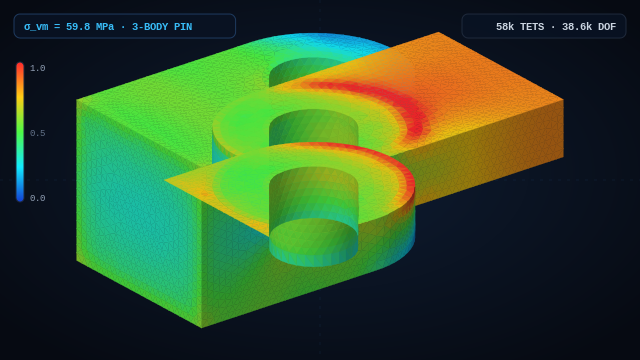
Aerospace Clevis, Lug & Shear Pin Joint
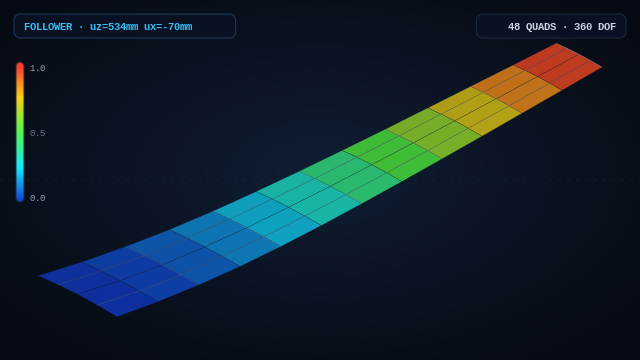
Large-Deflection Flexible UAV Wing under Follower Aerodynamic Pressure
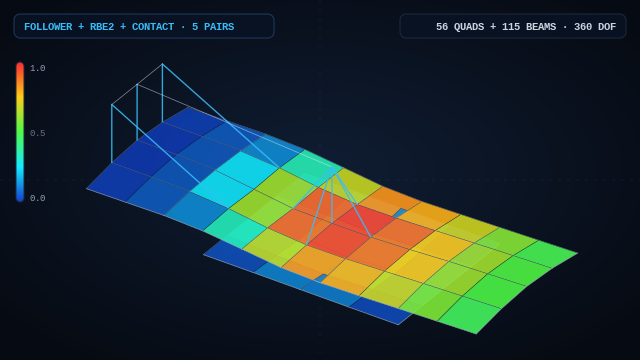
Wing Box Panel with Actuator RBE2 Bracket, Follower Aero Pressure & Stop Contact