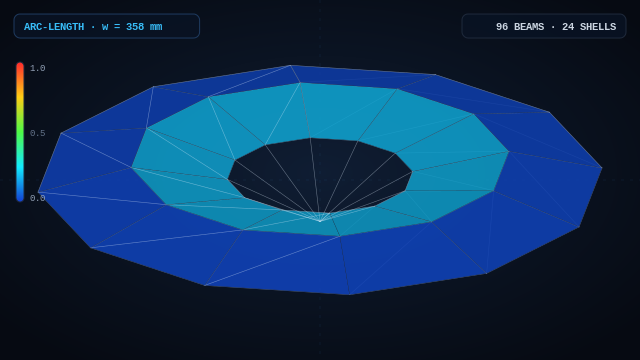
Inspecciona modelos prerresueltos en tu navegador en 2 s (hasta 300k GDL) o resuelve ensamblajes pesados de más de 1,5M GDL 100% sin conexión en Windows, macOS y Linux.
180 m Cargo Ship Hull with Framing
Verification of hull girder bending, transverse bulkhead racking, and free-free dry vibration modes under quiet water and wave loads.
A 180-meter cargo vessel undergoes cyclic sagging and hogging bending moments exceeding 2.1 GN·m alongside hydrostatic hull pressure. Designers must evaluate combined shell-stiffener stress distributions, double bottom transverse stiffness, and dry natural vibration frequencies without artificial boundary constraints. This WebCAE FEA model compares 3D multi-patch quad shell results directly against Timoshenko thin-walled girder theory with shear-flow corrections.
1. Geometría y malla FEA
- •Overall dimensions 180 × 28 × 16.5 m with 10.5 m design draft and 48,099 t total displacement (structural steel 6,082 t, machinery/superstructure 1,089 t, cargo 40,928 t).
- •53 structured quad-mesh shell patches comprising outer bottom, bilge strake (R = 2.5 m), vertical side shell, double bottom floor, second deck (z = 8.5 m), main deck, and 7 transverse bulkheads.
- •34,724 eccentric T-beam stiffeners (flush=inner) representing longitudinal stringers, side frames, deck girders, and transverse floor webs on shared mesh nodes.
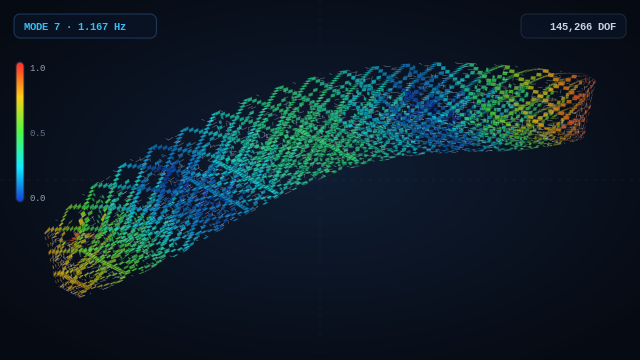
- •Mesh discretization totaling 27,216 MITC4 quads and 24,211 structural nodes (145,266 system DOFs).
2. Cargas y condiciones de contorno
- •Self-equilibrating static loads: gravity (frame gravity on), zone-distributed cargo on double bottom (4.5–10.8 t/m²), and cell-integrated hydrostatic water pressure.
- •Wave condition (λ = 180 m, wave height h = 9 m): balanced waterline elevation with trim/sinkage iterative equilibrium and 3-2-1 isostatic boundary soft supports.
- •Modal analysis in free-free configuration (free=on) shifting 6 rigid-body floating modes to extract unconstrained elastic hull girder vibration frequencies.
3. Resultados de simulación y conclusiones
- ✓Fundamental 2-node vertical hull girder bending frequency f₁ = 1.167 Hz (within 1.7% of Timoshenko girder reference with closed multi-cell shear flow).
- ✓Midship wave sagging deflection matches analytical reference within 0.38%; deck tensile stress matches within 1.9% at 2.1 GN·m bending moment.
- ✓Eigenvalue buckling factor under sagging wave load reaches λ₁ = 1.21 on upper deck panels between longitudinal stiffeners and transverse beams.
Marine engineering bureaus use WebCAE to conduct preliminary hull girder section scoping and vibration audits in seconds directly in the browser before exporting to classification society software. Pre-solved .wce project bundles allow shipyards and clients to interactively inspect stress contours and wave deflection shapes on any device without local CAD/CAE installations.
14 días de acceso completo a Pro. El primer cobro se realiza tras 14 días salvo cancelación previa.
- ✓Prueba de 14 días ($0 hoy) (cancela cuando quieras)
- ✓Hasta 1,5M+ GDL (solucionador disperso directo)
- ✓Apps nativas para Windows, macOS y Linux (100% offline)
- ✓Contacto no lineal y pandeo (Kσ, MITC4, RBE2/RBE3)
Pregunta a un ingeniero sobre tu modelo
Describe tu pieza, caso de carga o formato CAD — responderemos en 2 horas laborables.
¿Quieres una respuesta instantánea sobre teoría FEA o este modelo?
Haz clic en el chat de IA en la esquina inferior derecha para consultar sobre condiciones de contorno, criterios de tensión, convergencia de malla o scripts DSL.
Más casos de simulación de ingeniería
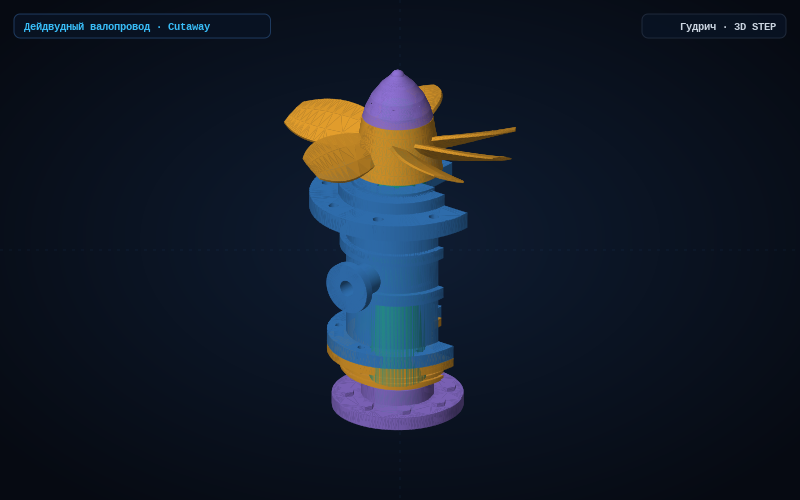
Marine Stern Tube Shafting & 5-Blade Propeller Cutaway (8 Bodies)
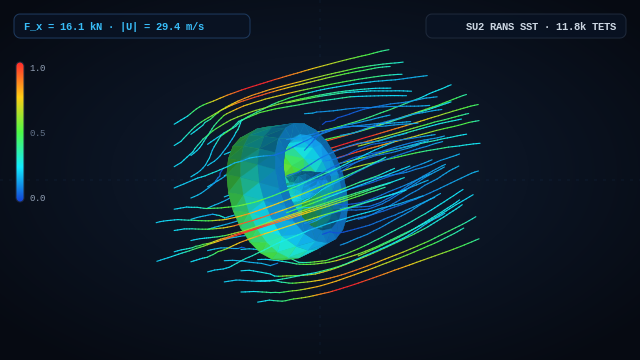
Kort Nozzle Ducted Marine Thruster with 3 Pitched Blades: Helical Wake (CFD)
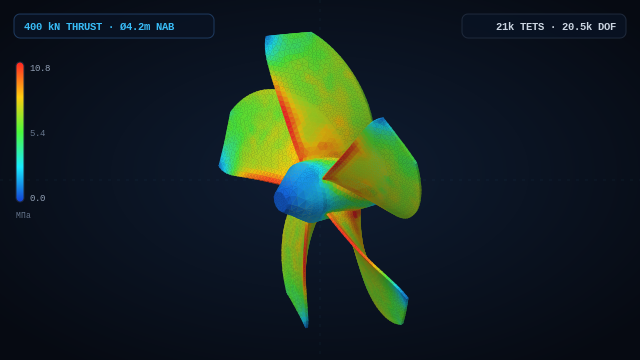
5-Blade Marine Propeller Ø4.2 m