Inspecciona modelos prerresueltos en tu navegador en 2 s (hasta 300k GDL) o resuelve ensamblajes pesados de más de 1,5M GDL 100% sin conexión en Windows, macOS y Linux.
Emergency Braking of Ventilated Caliper Shoe on Rail (Hybrid HEX8 + TET4)
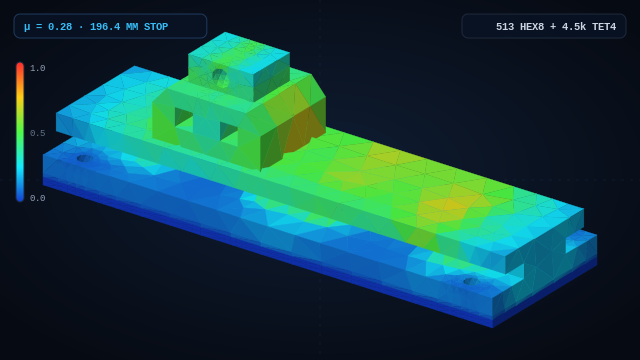
2-body B-Rep assembly of a ventilated brake shoe with cooling channels and suspension arch sliding along a profiled rail track on a conformal hybrid 513 HEX8 + 4,546 TET4 mesh with finite-kinematics HHT-α Coulomb friction.
During emergency rail braking, tangential Coulomb friction acts below the center of mass of the ventilated brake shoe, generating a nose-dive pitching moment that overloads the leading edge of the friction pad. This 2-body B-Rep model combines a 30-face rail track (with 3 swept HEX8 boundary layers on the base flange, minScaledJacobian = 0.323) and a 22-face ventilated brake shoe with transverse cooling slots and a pin-arch clevis. Solved over 220 implicit HHT-α time steps (875 Newton-Raphson iterations), the shoe decelerates from v₀ = 1.0 m/s to a full stop at 196.37 mm (within 2.29% of the analytical Coulomb stopping distance).
1. Geometría y malla FEA
- •2 B-Rep solid bodies (52 CAD faces total): profiled rail track (500 × 160 mm base with 4 fastener pockets and 2 web windows) and ventilated brake shoe (120 × 100 mm friction pad with 2 cooling channels and suspension arch).
- •Conformal hybrid mesh: 513 8-node hexahedra (HEX8) in 3 bottom flange layers node-matched to 4,546 4-node tetrahedra (TET4), totaling 2,050 nodes and 6,150 DOFs.
- •Coulomb frictional contact (μ = 0.28, slip regularization 1e-4 m) with finite-sliding kinematics across 21 saved time frames.
2. Cargas y condiciones de contorno
- •Rail bottom flange fixed across all translational DOFs (fix surface number 8).
- •Normal clamping acceleration load (az = −9.81 m/s²) ramped smoothly over t = 0…0.02 s.
- •Initial sliding velocity v₀ = {1.0, 0, 0} m/s prescribed on the ventilated brake shoe (Body 2).
3. Resultados de simulación y conclusiones
- ✓Full frictional arrest achieved at t = 0.44 s after 220 time steps and 875 Newton-Raphson iterations (3.98 iterations/step average).
- ✓Simulated stopping distance is 196.37 mm vs. analytical Coulomb benchmark 191.98 mm (2.285% relative error).
- ✓Leading-edge average von Mises stress (2,240.8 Pa, peak 4,598.2 Pa) is 1.15× higher than trailing-edge stress (1,948.7 Pa), capturing the physical nose-dive pitch.
WebCAE combines conformal HEX8 + TET4 hybrid meshing with implicit finite-kinematics Coulomb friction, enabling railway engineers to predict stopping distance, pad wear asymmetry, and nose-dive pitch stability.
14 días de acceso completo a Pro. El primer cobro se realiza tras 14 días salvo cancelación previa.
- ✓Prueba de 14 días ($0 hoy) (cancela cuando quieras)
- ✓Hasta 1,5M+ GDL (solucionador disperso directo)
- ✓Apps nativas para Windows, macOS y Linux (100% offline)
- ✓Contacto no lineal y pandeo (Kσ, MITC4, RBE2/RBE3)
Pregunta a un ingeniero sobre tu modelo
Describe tu pieza, caso de carga o formato CAD — responderemos en 2 horas laborables.
¿Quieres una respuesta instantánea sobre teoría FEA o este modelo?
Haz clic en el chat de IA en la esquina inferior derecha para consultar sobre condiciones de contorno, criterios de tensión, convergencia de malla o scripts DSL.
Más casos de simulación de ingeniería
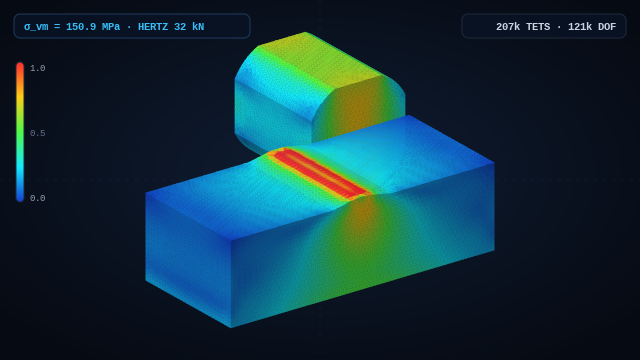
Cylindrical Bearing Roller on Raceway (Hertz Contact)
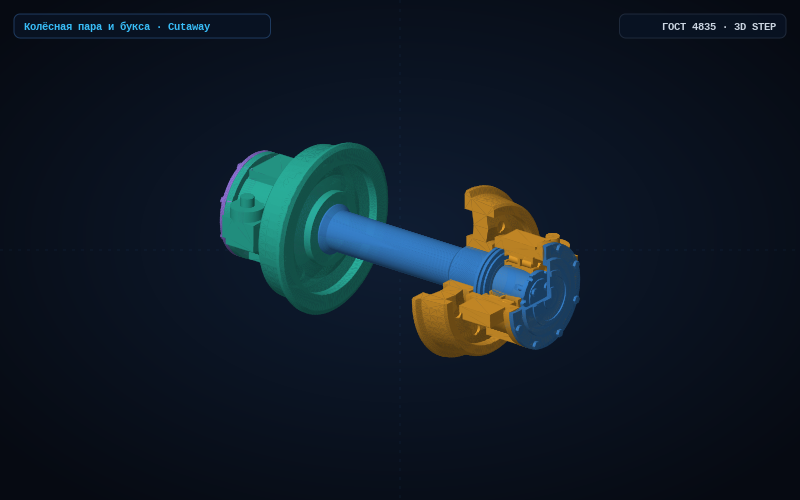
Railway Wheelset with Roller Bearing Axleboxes Cutaway (13 Bodies)
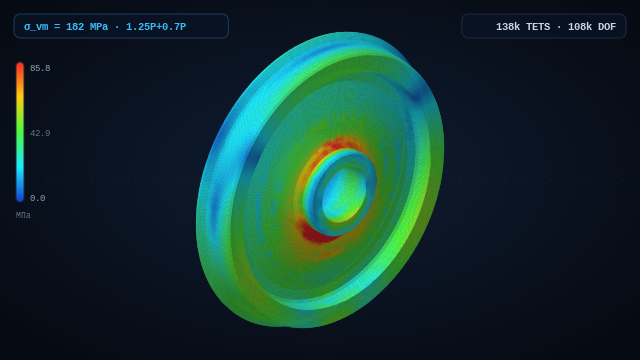
Monobloc Railway Wheel Ø957 mm