Nonlinear solve by increments: automatic step size and a Newton convergence chart
A nonlinear problem is not solved once. The load is applied in increments, the step size adapts to how hard each one turns out to be, and a new chart shows how many Newton iterations each increment cost — and where the solver had to back off and retry.
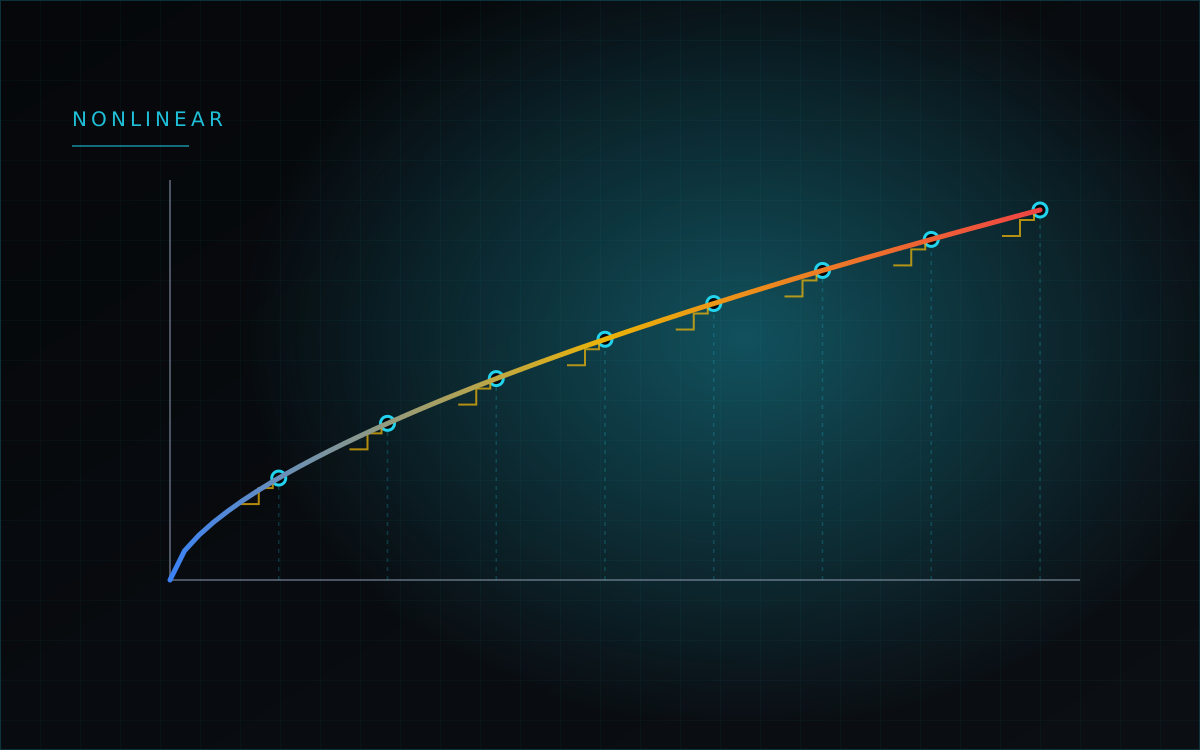
In a linear analysis the load is applied all at once, because the answer does not depend on the path taken to reach it. Contact breaks that assumption. Whether two surfaces touch depends on the deformation, and the deformation depends on which surfaces are touching. The only honest way through is to apply the load in increments and re-establish equilibrium at each one.
The step size adapts
The solver does not hold a fixed increment. When equilibrium comes easily the step grows; when an increment fails to converge it is halved and retried. This matters because the difficulty of a nonlinear problem is not spread evenly: most of a run is uneventful, and then one increment — the one where a contact zone closes, or a structure starts to soften — costs more iterations than everything before it.
The current load factor is now reported live while the solve runs. Before this, a nonlinear solve showed an empty progress bar for its entire duration, which is an unpleasant way to spend twenty minutes.
The convergence chart
Next to the linear solver's residual monitor there is now a second chart: Newton iterations against the load factor. Each bar is one increment, red if it failed to converge, with dashed markers where the solver cut the increment in half and tried again.
It answers a question the residual monitor cannot: is this model genuinely hard, or badly posed? A rising staircase of bars is a problem that is getting stiffer as it loads — normal. A wall of red at one particular load factor is something else entirely, and it is usually the model, not the solver.
Prescribed displacement ramps too
Loading by displacement rather than by force now follows the same increments: a prescribed 1 mm over four steps gives 0.25, 0.50, 0.75 and 1.00 mm, verified by test. For contact this matters — pushing a body into place in a single jump asks the solver to discover the whole contact region within one Newton solve.
Every increment is kept
Each converged increment saves a snapshot, and the Results tab plays them back as a load-step window with a slider and animation. Switching steps recomputes displacements and the stress state together — until recently the slider changed only the load-factor caption while the legend stayed identical from the first step to the last, and the snapshot itself was being taken from a truncated solution vector, so intermediate steps were misreporting their own values. Both are fixed.
What is not there yet
The animation is discrete: steps are shown as they were computed, with no interpolation between them. The snapshot stores the Newton iteration count but not the residual norm, so the convergence chart is drawn after the solve rather than updating during it. And this path is desktop-only for now.