October 2026 Release: Shells, Timoshenko Beams, B-Rep Imprinting, and Instant 3D Showcase in Browser WASM
A major update brings coupled 1D/2D structural analysis to WebCAE: MITC4 shells, Timoshenko beams with stiffener offsets, B-Rep curve imprinting, modal and buckling solvers, and compact .caeweb binary archives that reopen solved industrial assemblies in the browser without re-running.
Thin-walled structures like ship hulls, aircraft airframes, and civil containers are inefficient to mesh with millions of tiny solid tetrahedra. WebCAE now supports MITC4 (Mixed Interpolation of Tensorial Components) 4-node quadrilateral and 3-node triangular shell elements with formulation-level protection against shear and membrane locking. Alongside shells, 3D Timoshenko beam elements support axial, bending, transverse shear, and Saint-Venant torsional deformation across standard library profiles (rectangular, circular, pipe, I-beam, tee).
B-Rep curve imprinting and eccentric stiffeners
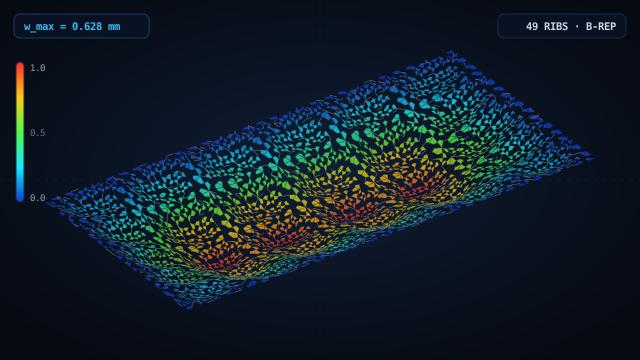
Reinforced panels require stiffening ribs placed directly on sheet edges. The new imprint command cuts 3D curves or datum planes across B-Rep sheet bodies and solid faces via Open CASCADE without tearing the body apart. Each imprinted boundary curve becomes a stable B-Rep edge with a persistent document number. The assign beam edges= command attaches Timoshenko beam stiffeners directly along these edges with shared mesh nodes and eccentric offsets (flush=outer, flush=inner, or ecc=), accurately accounting for Steiner parallel-axis inertia.
Parametric frame and shell modeling
The new frame subsystem generates complex space frames, trusses, and parametric shell patches with shared nodes via frame patch (quad, cylinder, cone, ruled, or explicit point grids) and frame stiffen (attaching beam ribs along patch mesh lines). The frame solve modal command computes natural frequencies and mode shapes, automatically handling 6 rigid-body modes for free-floating airframes and marine hulls (free=on), while frame solve buckling calculates critical elastic stability factors.
Direct browser WASM opening with .caeweb
Engineering models and solved results are now stored in unified .caeweb binary archives. Compressed with gzip, these containers bundle CAD B-Rep geometry, mesh elements, boundary conditions, and full solution fields (displacements, von Mises stresses, vibration modes, buckling factors). Opening a .caeweb file decompresses directly into browser WebAssembly memory: the 3D viewport immediately restores deformed shapes and color legends without re-running the solver.
Interactive 3D showcase
To demonstrate these capabilities, WebCAE includes an interactive showcase of pre-solved industrial models accessible directly from the app header: a framed ship hull (145k DOF, 27k quads, 35k beams), a full aircraft airframe (130k DOF), a pressurized fuselage barrel with door cutouts, a 60-story diagrid skyscraper (74k DOF), and a 49-rib stiffened aerospace panel.