Nine failure criteria, and a safety factor you can change without re-solving
Von Mises is the right answer for ductile metals and the wrong one for cast iron, concrete or a shaft under a million cycles. WebCAE now offers nine criteria — including Mohr-Coulomb, Drucker-Prager and three fatigue lines — and switching between them is instant.
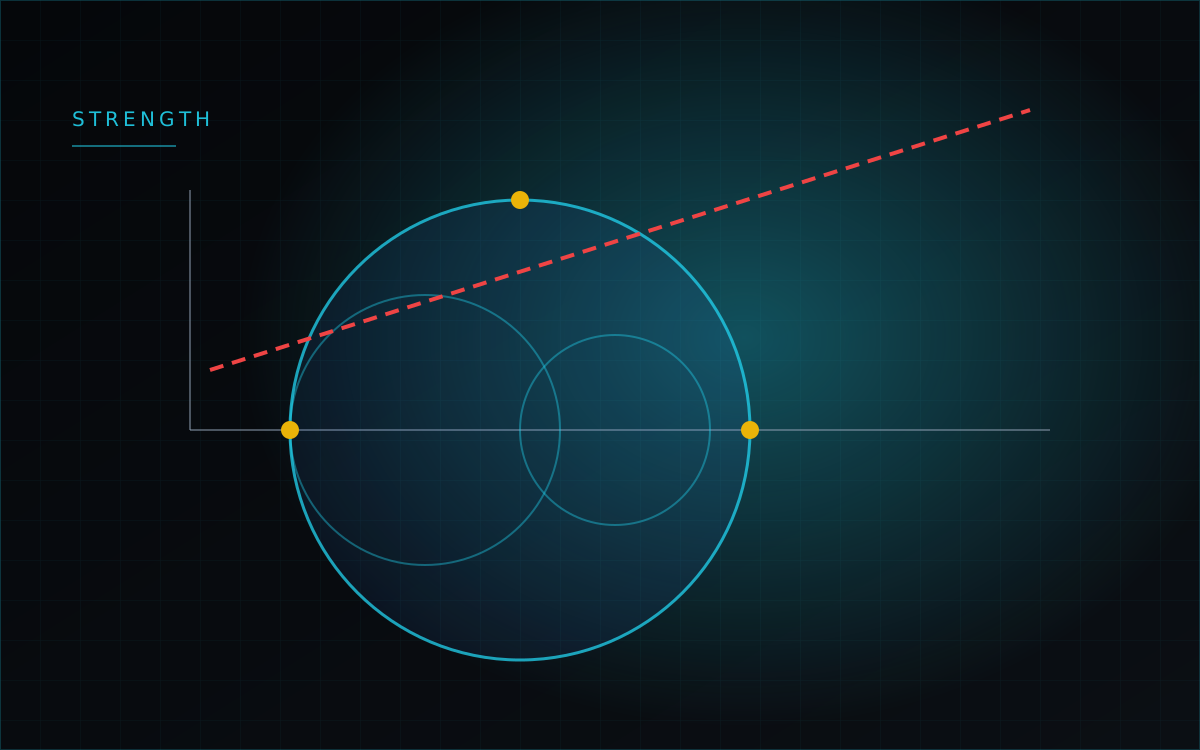
Every FEA package shows von Mises stress, and for a ductile metal loaded once that is exactly right: yielding is driven by distortion, and hydrostatic pressure barely matters. Apply the same criterion to grey cast iron, to concrete, to a soil, or to a shaft that will see ten million cycles, and it will confidently tell you the part is fine.
The Results tab now has a strength assessment panel with nine criteria and two ways of looking at the answer.
The criteria
For ductile materials: von Mises and Tresca, both against the yield stress. Tresca is the more conservative of the two by design.
For brittle and asymmetric materials — those that are much stronger in compression than in tension: Rankine on the maximum principal stress, Mohr-Coulomb combining both limits, and Drucker-Prager, which adds an explicit dependence on hydrostatic pressure derived from the tensile and compressive strengths. Saint-Venant, the maximum strain criterion, is there too, and it is the only one that needs Poisson's ratio.
For cyclic loading: Goodman, Soderberg and Gerber, each combining the alternating and mean components against the endurance limit and, respectively, the tensile strength, the yield stress and the tensile strength squared. Soderberg is the conservative choice; Gerber, being parabolic, is the least conservative of the three. Given the same stress state, the three give visibly different numbers — that spread is the point, not a defect.
Safety factor or utilization
The panel computes both maps at once and lets you switch between them: the factor of safety, and the utilization — the fraction of the allowable that is being used. Set the required factor, and a status line reports plainly whether the model clears it: the limit is exceeded, the margin is below what you asked for, or the requirement is met. There is a display cap on the factor, because at zero stress the safety factor is mathematically infinite and a colour map of infinity is not useful.
It does not re-solve
The strength assessment is a pure post-processing step on the stress field. Changing the criterion, the allowable or the required factor recomputes the map immediately — no solve. This is what makes it usable in practice: comparing Goodman with Soderberg on the same result takes a second, so the choice of criterion becomes a decision you can explore rather than one you commit to before the run.
When the material data is missing
Every criterion needs specific material constants, and a criterion without its constants is where quiet nonsense enters an analysis. Rather than saying "insufficient data", the panel names the exact missing quantity for the exact criterion — "the Drucker-Prager criterion has no tensile strength defined in the material model", "the Goodman calculation has no endurance limit" — and offers a button that takes you straight to the material properties. Fourteen distinct diagnoses cover the combinations.
The strength inputs live on a dedicated tab of the material step: yield stress, tensile strength, compressive strength and endurance limit, all stored in SI.
Reading the result in the right frame
Alongside this, results can now be reported in any coordinate system you have defined, including cylindrical: six components each of stress and strain, the displacement components, and the principal stresses. In a cylindrical frame the labels follow the physics — radial, hoop and axial stress, radial and circumferential displacement — because for a pressure vessel or a shaft those are the numbers you actually want, and reading them off a global Cartesian field is an invitation to error.
Solid elements have no rotational degrees of freedom, so the rotation of a continuum is now recovered in post-processing as half the curl of the displacement field, for both first- and second-order tetrahedra.
One limitation worth stating: the strength map is not yet available for multi-material assemblies, and the panel says so directly instead of silently applying one material's allowable to all of them.