Inspecciona modelos prerresueltos en tu navegador en 2 s (hasta 300k GDL) o resuelve ensamblajes pesados de más de 1,5M GDL 100% sin conexión en Windows, macOS y Linux.
Reusable Rocket Booster Titanium 3×3 Lattice Grid Fin Aerodynamics & Wake (CFD)
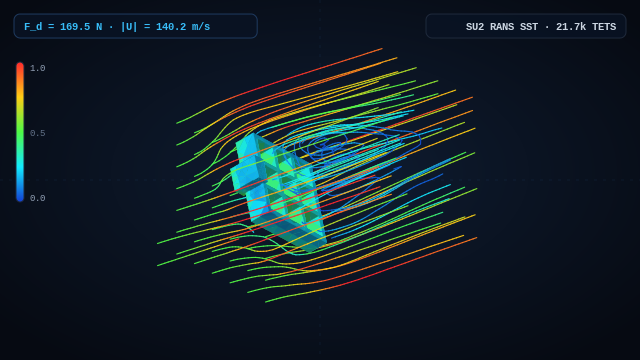
3D external aerodynamics (RANS k-ω SST, U_∞ = 65 m/s, α = 12°) of a 3×3 cellular lattice rocket grid fin with an asymmetric titanium actuator root fairing in a virtual wind tunnel, resolving inter-cell channel acceleration up to 140.2 m/s and multi-plume wake vortices.
Reusable first-stage rocket boosters (such as Falcon 9 and Super Heavy) and precision aerodynamic stages use lattice grid fins—short-chord orthogonal honeycombs of thin intersecting webs—because they generate high normal control force at steep angles of attack without catastrophic stall and require minimal hinge torque around the actuator spindle. This 3D CFD model embeds a 230 × 230 mm 3×3 lattice grid fin (chord 55 mm, outer frame thickness 12 mm, internal web thickness 10 mm, 9 open 62 × 62 mm cells, plus a titanium actuator root lug fairing) pitched at α = 12° inside a 680 × 440 × 440 mm virtual wind tunnel at U_∞ = 65.0 m/s. Solved in native SU2_CFD (Menter k-ω SST), the simulation resolves flow turning and vena-contracta acceleration inside the 9 inclined lattice cells up to |U|_max = 140.20 m/s (2.16× freestream speed), stagnation pressure on the windward web leading edges (+11,847.7 Pa), leeward cell suction (−4,309.7 Pa), integrated normal lift force F_L = 19.23 N (C_L = 0.2582), axial aerodynamic braking drag F_D = 169.50 N (C_D = 2.2753), and an intense 9-jet wake vortex matrix (Q_max = 5.53×10⁶ s⁻²).
1. Geometría y malla FEA
- •Single B-Rep fluid control volume (D_fluid = WindTunnel − GridFin, 56 topological faces, V = 130.49×10⁶ mm³): 680 mm streamwise length (X ∈ [−220, 460] mm), 440 mm width (Y ∈ [−220, 220] mm), and 440 mm height (Z ∈ [−220, 220] mm).
- •3×3 cellular lattice grid fin (230 × 230 × 55 mm frame, two vertical and two horizontal internal webs forming 9 open 62 × 62 mm flow channels) with root actuator fairing block, pitched at α = +12° around the Y axis.
- •Unstructured 3D tetrahedral mesh generated by Netgen: 21,661 tetrahedra and 5,074 nodes (volume discretization error 0.00%).
- •Working fluid: standard air (ρ = 1.204 kg/m³, μ = 1.825×10⁻⁵ Pa·s) with Menter k-ω SST turbulence model.
2. Cargas y condiciones de contorno
- •Upstream wind-tunnel inlet face at X = −220 mm (surface number 1): uniform air velocity U_in = 65.0 m/s along +X ([1, 0, 0]).
- •Downstream wind-tunnel exit face at X = +460 mm (surface number 6): static gauge pressure p_out = 0 Pa.
- •Four outer tunnel walls at Y = ±220 mm and Z = ±220 mm (surfaces 2, 3, 4, 5): slip / symmetry boundary condition.
- •All 50 internal wet surfaces of the 3×3 grid fin frame, intersecting webs, and actuator lug (surfaces 7–56): viscous no-slip wall with aerodynamic force monitoring (monitor=on).
3. Resultados de simulación y conclusiones
- ✓Channel blockage and 12° incidence accelerate the airflow through the 9 honeycomb cells from 65.0 m/s up to |U|_max = 140.20 m/s (2.16× freestream speed).
- ✓Integrated aerodynamic loads on the grid fin: normal control lift force F_L = 19.233 N (C_L = 0.2582) and axial aerodynamic braking drag F_D = 169.499 N (C_D = 2.2753).
- ✓Intersecting web wakes generate a dense 3×3 matrix of trailing vortex tubes with peak vorticity |ω|_max = 4,454.4 s⁻¹ and Q_max = 5.53×10⁶ s⁻², while tunnel mass conservation holds within 0.06% (15.149 vs. 15.158 kg/s).
Flight-control and launch-vehicle engineers use WebCAE CFD to evaluate grid fin web thickness, cell aspect ratios, hinge moments, and aerodynamic braking drag across descent angles of attack.
14 días de acceso completo a Pro. El primer cobro se realiza tras 14 días salvo cancelación previa.
- ✓Prueba de 14 días ($0 hoy) (cancela cuando quieras)
- ✓Hasta 1,5M+ GDL (solucionador disperso directo)
- ✓Apps nativas para Windows, macOS y Linux (100% offline)
- ✓Contacto no lineal y pandeo (Kσ, MITC4, RBE2/RBE3)
Pregunta a un ingeniero sobre tu modelo
Describe tu pieza, caso de carga o formato CAD — responderemos en 2 horas laborables.
¿Quieres una respuesta instantánea sobre teoría FEA o este modelo?
Haz clic en el chat de IA en la esquina inferior derecha para consultar sobre condiciones de contorno, criterios de tensión, convergencia de malla o scripts DSL.
Más casos de simulación de ingeniería
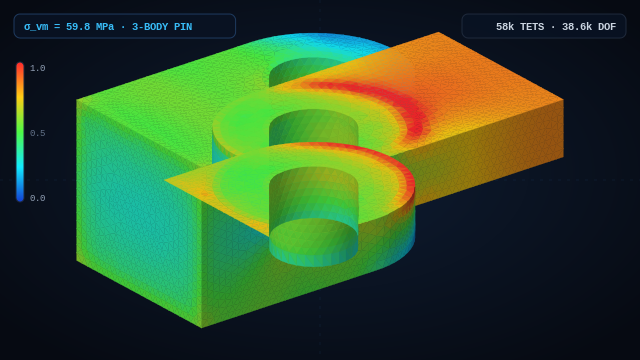
Aerospace Clevis, Lug & Shear Pin Joint
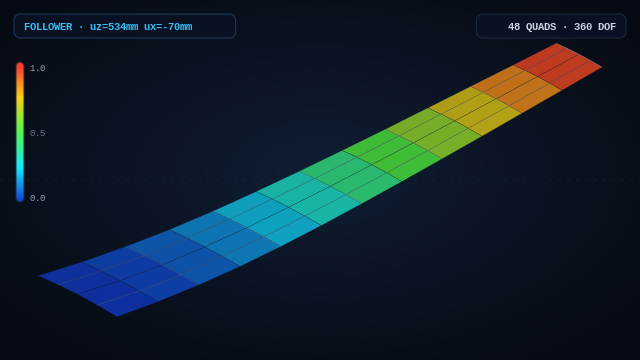
Large-Deflection Flexible UAV Wing under Follower Aerodynamic Pressure
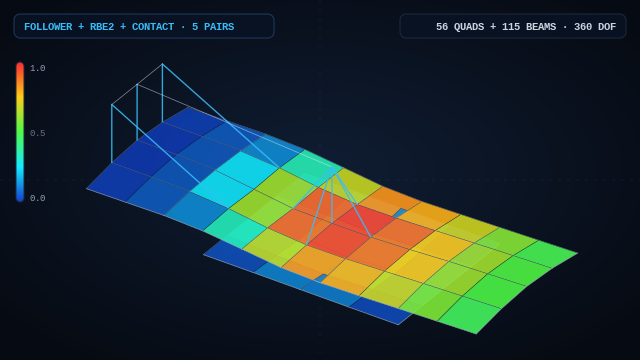
Wing Box Panel with Actuator RBE2 Bracket, Follower Aero Pressure & Stop Contact