Inspect pre-solved models in your browser in 2 seconds (up to 300k DOF) or solve 1.5M+ DOF assemblies 100% offline on Windows and macOS.
Reusable Rocket Booster Titanium 3×3 Lattice Grid Fin Aerodynamics & Wake (CFD)
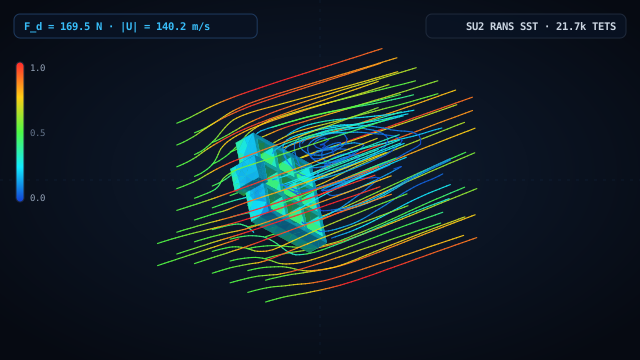
3D external aerodynamics (RANS k-ω SST, U_∞ = 65 m/s, α = 12°) of a 3×3 cellular lattice rocket grid fin with an asymmetric titanium actuator root fairing in a virtual wind tunnel, resolving inter-cell channel acceleration up to 140.2 m/s and multi-plume wake vortices.
Reusable first-stage rocket boosters (such as Falcon 9 and Super Heavy) and precision aerodynamic stages use lattice grid fins—short-chord orthogonal honeycombs of thin intersecting webs—because they generate high normal control force at steep angles of attack without catastrophic stall and require minimal hinge torque around the actuator spindle. This 3D CFD model embeds a 230 × 230 mm 3×3 lattice grid fin (chord 55 mm, outer frame thickness 12 mm, internal web thickness 10 mm, 9 open 62 × 62 mm cells, plus a titanium actuator root lug fairing) pitched at α = 12° inside a 680 × 440 × 440 mm virtual wind tunnel at U_∞ = 65.0 m/s. Solved in native SU2_CFD (Menter k-ω SST), the simulation resolves flow turning and vena-contracta acceleration inside the 9 inclined lattice cells up to |U|_max = 140.20 m/s (2.16× freestream speed), stagnation pressure on the windward web leading edges (+11,847.7 Pa), leeward cell suction (−4,309.7 Pa), integrated normal lift force F_L = 19.23 N (C_L = 0.2582), axial aerodynamic braking drag F_D = 169.50 N (C_D = 2.2753), and an intense 9-jet wake vortex matrix (Q_max = 5.53×10⁶ s⁻²).
1. Geometry & FEA Mesh
- •Single B-Rep fluid control volume (D_fluid = WindTunnel − GridFin, 56 topological faces, V = 130.49×10⁶ mm³): 680 mm streamwise length (X ∈ [−220, 460] mm), 440 mm width (Y ∈ [−220, 220] mm), and 440 mm height (Z ∈ [−220, 220] mm).
- •3×3 cellular lattice grid fin (230 × 230 × 55 mm frame, two vertical and two horizontal internal webs forming 9 open 62 × 62 mm flow channels) with root actuator fairing block, pitched at α = +12° around the Y axis.
- •Unstructured 3D tetrahedral mesh generated by Netgen: 21,661 tetrahedra and 5,074 nodes (volume discretization error 0.00%).
- •Working fluid: standard air (ρ = 1.204 kg/m³, μ = 1.825×10⁻⁵ Pa·s) with Menter k-ω SST turbulence model.
2. Loads & Boundary Conditions
- •Upstream wind-tunnel inlet face at X = −220 mm (surface number 1): uniform air velocity U_in = 65.0 m/s along +X ([1, 0, 0]).
- •Downstream wind-tunnel exit face at X = +460 mm (surface number 6): static gauge pressure p_out = 0 Pa.
- •Four outer tunnel walls at Y = ±220 mm and Z = ±220 mm (surfaces 2, 3, 4, 5): slip / symmetry boundary condition.
- •All 50 internal wet surfaces of the 3×3 grid fin frame, intersecting webs, and actuator lug (surfaces 7–56): viscous no-slip wall with aerodynamic force monitoring (monitor=on).
3. Simulation Results & Findings
- ✓Channel blockage and 12° incidence accelerate the airflow through the 9 honeycomb cells from 65.0 m/s up to |U|_max = 140.20 m/s (2.16× freestream speed).
- ✓Integrated aerodynamic loads on the grid fin: normal control lift force F_L = 19.233 N (C_L = 0.2582) and axial aerodynamic braking drag F_D = 169.499 N (C_D = 2.2753).
- ✓Intersecting web wakes generate a dense 3×3 matrix of trailing vortex tubes with peak vorticity |ω|_max = 4,454.4 s⁻¹ and Q_max = 5.53×10⁶ s⁻², while tunnel mass conservation holds within 0.06% (15.149 vs. 15.158 kg/s).
Flight-control and launch-vehicle engineers use WebCAE CFD to evaluate grid fin web thickness, cell aspect ratios, hinge moments, and aerodynamic braking drag across descent angles of attack.
14 days of full Pro access. The first charge occurs only after 14 days unless canceled beforehand.
- ✓14-Day Trial ($0 Today) (cancel anytime)
- ✓Up to 1.5M+ DOFs (direct sparse solver)
- ✓Native Windows & macOS Apps (100% offline)
- ✓Nonlinear Contact & Buckling (Kσ, MITC4, RBE2/RBE3)
Ask an Engineer About Your Model
Describe your part, load case, or CAD format — we reply within 2 business hours.
Want an instant answer on FEA theory or this model?
Click the AI chat button in the bottom-right corner to ask about boundary conditions, stress criteria, mesh convergence, or DSL scripting.
More Engineering Simulation Cases
Aerospace Clevis, Lug & Shear Pin Joint
Large-Deflection Flexible UAV Wing under Follower Aerodynamic Pressure
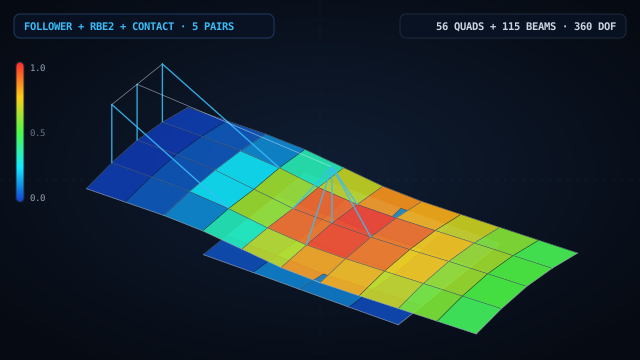
Wing Box Panel with Actuator RBE2 Bracket, Follower Aero Pressure & Stop Contact