Inspect pre-solved models in your browser in 2 seconds (up to 300k DOF) or solve 1.5M+ DOF assemblies 100% offline on Windows and macOS.
Wing Box Panel with Actuator RBE2 Bracket, Follower Aero Pressure & Stop Contact
Geometrically nonlinear 3D cambered aeroelastic wing section combining an upper hydraulic actuator pylon and 5-slave RBE2 bellcrank (z = 0.25 m), live follower aerodynamic pressure, and unilateral contact against a lower stop cradle (z = 0.0 m).
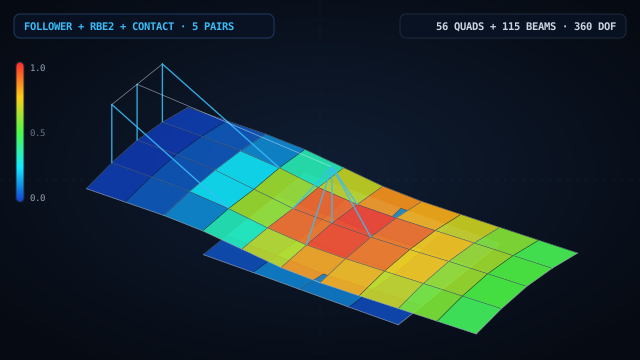
High-load wing control surfaces and cambered wing box panels operate under coupled aeroelastic forces: distributed aerodynamic pressure that rotates with the deformed surface normal (follower pressure), actuator forces introduced through elevated bellcrank fittings above the wing contour, and lower travel-limiting stop cradles that arrest excessive downward deflection during high-g maneuvers. This 3D WebCAE model represents a 1.50 × 0.60 m cambered aviation aluminum wing section (40 MITC4 quads of t₁ = 5 mm at z(y) = 68…90 mm, stiffened by 5 longitudinal stringers and 7 arched ribs), an elevated hydraulic actuator bellcrank apex at z = 0.25 m (linked via a 5-leg pyramidal RBE2 spider to the central rib and connected by a Ø52 mm hydraulic cylinder rod to the root pylon), and a lower protective stop cradle at z = 0.0 m (0.60 × 0.56 m, 16 MITC4 quads of t₂ = 10 mm). Under combined actuator load (Fx = -12 kN, Fz = -28 kN) and live follower suction/pressure (950–1350 Pa), the wing deflects by -3.01 mm while remaining well above the lower cradle (minimum deformed skin height z = 65.7 mm), engaging 5 contact pairs across the elastomer bumper pads and deflecting the stop cradle by -1.76 mm.
1. Geometry & FEA Mesh
- •84 nodes, 56 MITC4 shell quads, 115 beam elements, 360 active DOFs.
- •Cambered wing skin: span 1.50 m, chord 0.60 m, arched profile z(y) = 68…90 mm, thickness t₁ = 5 mm, 5 stringers (14 × 22 mm) and 7 curved ribs (16 × 24 mm).
- •Upper actuator pylon & bellcrank: root pylon at (x = 0, z = 0.25 m), hydraulic cylinder rod Ø52 × 7 mm, and pyramidal RBE2 bellcrank master node 81 at (0.75, 0.30, 0.25 m) coupled to 5 wing rib/stringer nodes.
- •Lower stop cradle: 0.60 × 0.56 m plate, t₂ = 10 mm at z = 0.0 m (68–90 mm below the wing skin) reinforced with 20 × 22 mm grid ribs.
2. Loads & Boundary Conditions
- •Full 6-DOF clamping of wing root nodes (x = 0 m, z = 68…90 mm) and actuator root pylon (x = 0 m, z = 0.25 m).
- •Clamped boundary support around the lower stop cradle perimeter (z = 0.0 m).
- •Actuator combined thrust Fx = -12 kN and Fz = -28 kN applied at bellcrank RBE2 master node 81.
- •Spanwise varying live follower aerodynamic pressure: p = -950…-1350 Pa on all 40 cambered wing quads.
- •Two-sided shell contact across bumper pads (slaveoffset = 40 mm, masteroffset = 41.5 mm, penalty = 1.8e8 N/m).
3. Simulation Results & Findings
- ✓Nonlinear static solution converges in 6 steps (19 Newton iterations, 0 cutbacks) with constraintMaxViolation = 0.
- ✓5 active contact pairs engage the bumper pads: wing skin deflects by u_z = -3.01 mm (remaining at z ≥ 65.7 mm) and transfers load to the stop cradle (u_z = -1.76 mm), with tip axial foreshortening u_x = -0.082 mm.
- ✓Linear buckling analysis yields critical load factor λ₁ = 6.46.
- ✓Modal analysis yields first aeroelastic wing section frequency f₁ = 28.69 Hz.
Enables aerospace structural engineers to evaluate 3D cambered wing deformation under live follower loads, elevated actuator bellcrank forces, and lower stop cradle contact in a single clean spatial model.
14 days of full Pro access. The first charge occurs only after 14 days unless canceled beforehand.
- ✓14-Day Trial ($0 Today) (cancel anytime)
- ✓Up to 1.5M+ DOFs (direct sparse solver)
- ✓Native Windows & macOS Apps (100% offline)
- ✓Nonlinear Contact & Buckling (Kσ, MITC4, RBE2/RBE3)
Ask an Engineer About Your Model
Describe your part, load case, or CAD format — we reply within 2 business hours.
Want an instant answer on FEA theory or this model?
Click the AI chat button in the bottom-right corner to ask about boundary conditions, stress criteria, mesh convergence, or DSL scripting.
More Engineering Simulation Cases
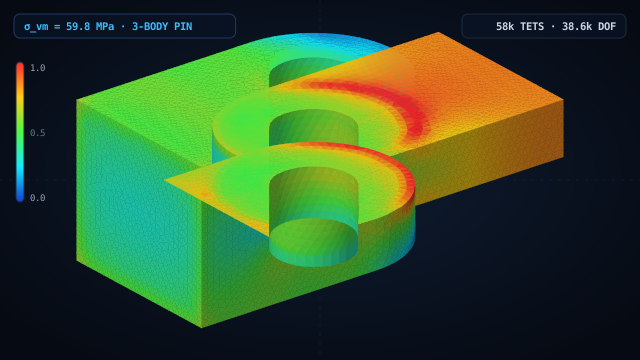
Aerospace Clevis, Lug & Shear Pin Joint
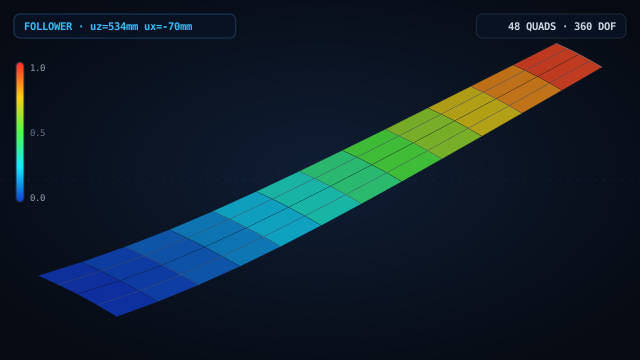
Large-Deflection Flexible UAV Wing under Follower Aerodynamic Pressure
Swept UAV Wing with Tip Winglet: Wingtip Vortex & Lift/Drag (CFD)