Inspecciona modelos prerresueltos en tu navegador en 2 s (hasta 300k GDL) o resuelve ensamblajes pesados de más de 1,5M GDL 100% sin conexión en Windows, macOS y Linux.
ISS Pressurized Station Module
Free-free orbital vibration modes, internal atmospheric pressure containment, and launch trunnion g-load stress verification.
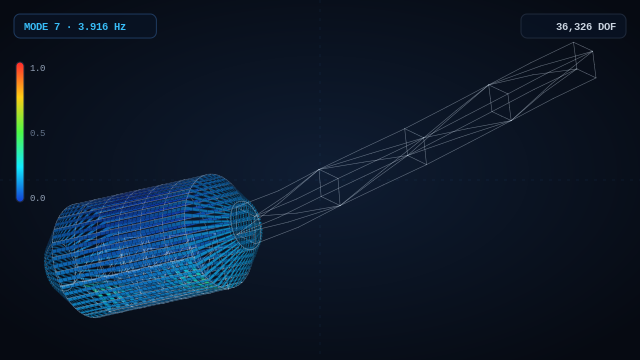
Pressurized orbital habitat modules (such as Destiny or Columbus) must withstand 101.3 kPa internal atmospheric pressure, survive 6g longitudinal and 3g lateral launch loads on shuttle/fairing trunnions, and maintain orbital dynamic stiffness when coupled to external truss segments. The model incorporates conical bulkheads, Common Berthing Mechanism (CBM) rings, internal equipment racks with 4.8 t payload, and an external 16-meter square truss. WebCAE computes unconstrained free-free natural frequencies and localized stresses around docking interfaces.
1. Geometría y malla FEA
- •Pressure hull: cylindrical barrel R = 2.1 m, length 6.0 m, t = 4 mm aluminum shell, capped by forward/aft truncated cones (2.1 → 1.0 m, t = 5 mm).
- •Docking & hatch closures: CBM annular rings (ruled, t = 12 mm) with box ring stiffeners (100 × 80 × 10 mm) and transfinite quad mesh end hatch covers (t = 30 mm).
- •Framing & interior: 24 longitudinal stringers, ring frames at 1.0 m pitch, suspended honeycomb equipment floor (t = 30 mm), and 14 equipment racks totaling 4,800 kg.
- •External structure: 16-meter square tubular truss (4 bays × 4 m) directly integrated with forward hatch bulkhead nodes on shared mesh vertices.
2. Cargas y condiciones de contorno
- •Internal pressurization p = 101.3 kPa applied to barrel, cones, and end hatches with self-equilibrating axial force on end closures.
- •Launch acceleration: 6g axial inertia combined with 3g lateral load applied to 9.46 t system mass supported on 3-point trunnion/keel mounts.
- •Unconstrained free-free orbital vibration mode extraction (free=on) filtering out 6 rigid-body space mechanics translations/rotations.
3. Resultados de simulación y conclusiones
- ✓Orbital free-free elastic natural frequencies: f₁ = 3.916 Hz and f₂ = 4.139 Hz (coupled module-truss bending with 14 lumped rack masses).
- ✓Barrel membrane hoop stress σ_θ = 53.15 MPa and axial stress σ_x = 26.58 MPa match thin-shell analytical reference within 0.05%.
- ✓Zero topology gaps verified across all conic-to-barrel transitions and hatch disc boundaries (shellcheck = 0).
Space hardware developers leverage WebCAE to rapidly assess module primary structure frequencies, rack payload placement, and trunnion peak launch stresses in an ultra-responsive web environment. Fully solved .wce orbital cases enable international space consortium partners to examine dynamic modes and local stresses without specialized software licenses.
14 días de acceso completo a Pro. El primer cobro se realiza tras 14 días salvo cancelación previa.
- ✓Prueba de 14 días ($0 hoy) (cancela cuando quieras)
- ✓Hasta 1,5M+ GDL (solucionador disperso directo)
- ✓Apps nativas para Windows, macOS y Linux (100% offline)
- ✓Contacto no lineal y pandeo (Kσ, MITC4, RBE2/RBE3)
Pregunta a un ingeniero sobre tu modelo
Describe tu pieza, caso de carga o formato CAD — responderemos en 2 horas laborables.
¿Quieres una respuesta instantánea sobre teoría FEA o este modelo?
Haz clic en el chat de IA en la esquina inferior derecha para consultar sobre condiciones de contorno, criterios de tensión, convergencia de malla o scripts DSL.
Más casos de simulación de ingeniería
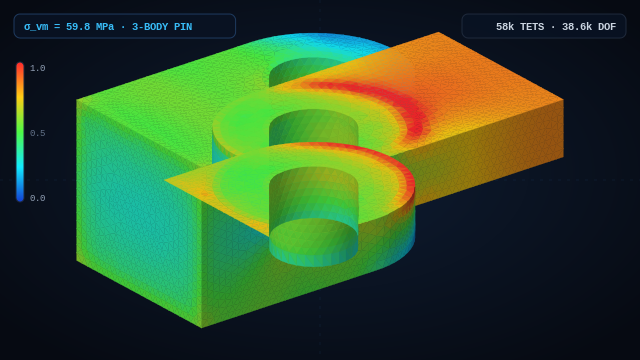
Aerospace Clevis, Lug & Shear Pin Joint
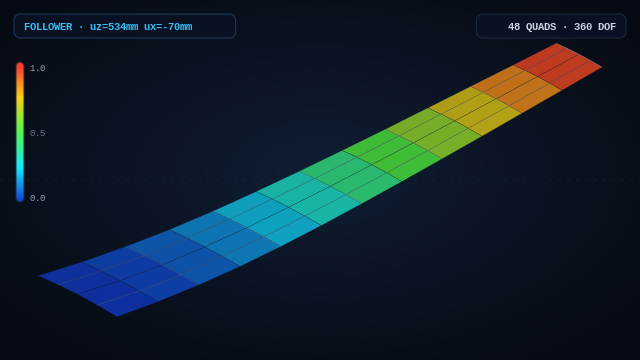
Large-Deflection Flexible UAV Wing under Follower Aerodynamic Pressure
Wing Box Panel with Actuator RBE2 Bracket, Follower Aero Pressure & Stop Contact