Inspect pre-solved models in your browser in 2 seconds (up to 300k DOF) or solve 1.5M+ DOF assemblies 100% offline on Windows and macOS.
ISS Pressurized Station Module
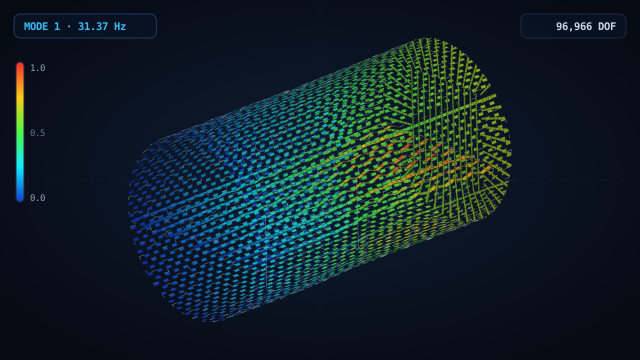
Free-free orbital vibration modes, internal atmospheric pressure containment, and launch trunnion g-load stress verification.
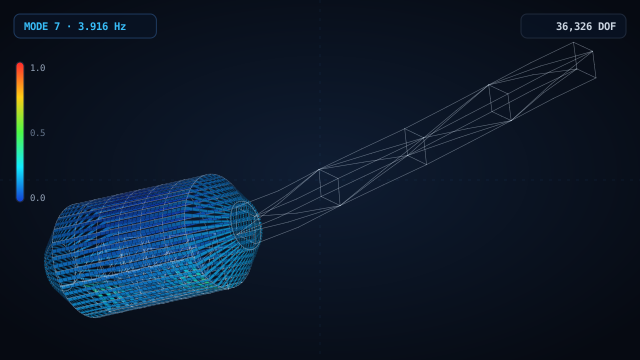
Pressurized orbital habitat modules (such as Destiny or Columbus) must withstand 101.3 kPa internal atmospheric pressure, survive 6g longitudinal and 3g lateral launch loads on shuttle/fairing trunnions, and maintain orbital dynamic stiffness when coupled to external truss segments. The model incorporates conical bulkheads, Common Berthing Mechanism (CBM) rings, internal equipment racks with 4.8 t payload, and an external 16-meter square truss. WebCAE computes unconstrained free-free natural frequencies and localized stresses around docking interfaces.
1. Geometry & FEA Mesh
- •Pressure hull: cylindrical barrel R = 2.1 m, length 6.0 m, t = 4 mm aluminum shell, capped by forward/aft truncated cones (2.1 → 1.0 m, t = 5 mm).
- •Docking & hatch closures: CBM annular rings (ruled, t = 12 mm) with box ring stiffeners (100 × 80 × 10 mm) and transfinite quad mesh end hatch covers (t = 30 mm).
- •Framing & interior: 24 longitudinal stringers, ring frames at 1.0 m pitch, suspended honeycomb equipment floor (t = 30 mm), and 14 equipment racks totaling 4,800 kg.
- •External structure: 16-meter square tubular truss (4 bays × 4 m) directly integrated with forward hatch bulkhead nodes on shared mesh vertices.
2. Loads & Boundary Conditions
- •Internal pressurization p = 101.3 kPa applied to barrel, cones, and end hatches with self-equilibrating axial force on end closures.
- •Launch acceleration: 6g axial inertia combined with 3g lateral load applied to 9.46 t system mass supported on 3-point trunnion/keel mounts.
- •Unconstrained free-free orbital vibration mode extraction (free=on) filtering out 6 rigid-body space mechanics translations/rotations.
3. Simulation Results & Findings
- ✓Orbital free-free elastic natural frequencies: f₁ = 3.916 Hz and f₂ = 4.139 Hz (coupled module-truss bending with 14 lumped rack masses).
- ✓Barrel membrane hoop stress σ_θ = 53.15 MPa and axial stress σ_x = 26.58 MPa match thin-shell analytical reference within 0.05%.
- ✓Zero topology gaps verified across all conic-to-barrel transitions and hatch disc boundaries (shellcheck = 0).
Space hardware developers leverage WebCAE to rapidly assess module primary structure frequencies, rack payload placement, and trunnion peak launch stresses in an ultra-responsive web environment. Fully solved .caeweb orbital cases enable international space consortium partners to examine dynamic modes and local stresses without specialized software licenses.
14 days of full Pro access. The first charge occurs only after 14 days unless canceled beforehand.
- ✓14-Day Trial ($0 Today) (cancel anytime)
- ✓Up to 1.5M+ DOFs (direct sparse solver)
- ✓Native Windows & macOS Apps (100% offline)
- ✓Nonlinear Contact & Buckling (Kσ, MITC4, RBE2/RBE3)
Ask an Engineer About Your Model
Describe your part, load case, or CAD format — we reply within 2 business hours.
Want an instant answer on FEA theory or this model?
Click the AI chat button in the bottom-right corner to ask about boundary conditions, stress criteria, mesh convergence, or DSL scripting.
More Engineering Simulation Cases
Machined Dual-Lug Wing Attachment Fitting
Transport Aircraft Airframe
Fuselage Barrel Section with Door Cutout