October 2026 Recap & November–December Roadmap: Full UI Redesign, WebCAE 101, YouTube Tutorials, Stability and Speed
In October we completed our major solver, meshing, and multiphysics milestones — shipping hex-tet hybrid meshes, Coulomb frictional contact, coupled thermoelasticity, Two-Way FSI, composite laminates, 213 verified benchmarks, and a 4-language Reference Manual. In November and December our focus shifts to a complete UI redesign, the WebCAE 101 course, YouTube walkthroughs, stabilization, bug fixing, and solver speed.
- Verified benchmarks
- 213 cases
- 3D Showcase library
- 71+ .wce models
- Reference Manual
- 15 chapters · 4 languages
- Nov–Dec priority
- UI Redesign · 101 · Speed
Over the past month, WebCAE's simulation kernel grew faster than its user interface. Every item originally scheduled on our autumn solver roadmap — along with several capabilities planned for early 2027 — is now implemented, verified against analytical and NAFEMS references, and available in the engine. Here is a summary of what shipped in October 2026 and what we are building in November and December.
What we completed in October 2026
1. Beam, shell, and stiffened-panel structures: 4-node MITC4 shells and 6-DOF Timoshenko beams with rigid end eccentricities (STRUCT_BEAM_EXT) and moment hinge releases, B-Rep curve imprinting for stiffening ribs, linear buckling, free-free modal analysis, geometrically nonlinear (NLGEOM) arc-length snap-through and follower pressure, plus automated dimensional reduction from 3D STEP assemblies into conformal beam-shell models.
2. Hexahedral, hybrid, and adaptive meshing: 1st- and 2nd-order hexahedra (hex8, hex20, hex27) with pyramid (pyr5, pyr13) and wedge transitions for conformal hex-tet hybrid zones, prismatic boundary-layer inflation, Zienkiewicz–Zhu superconvergent patch recovery (ZZ-SPR) adaptive remeshing, and automated local submodeling.
3. Multi-body CAD assemblies and nonlinear contact: unilateral Mortar contact with Coulomb friction, multi-step rotational and planetary gear kinematics, RBE2/RBE3 kinematic spiders, BVH collision broadphase, and automated assembly connectivity verification tested on assemblies of up to 102 parts.
4. Advanced constitutive laws and coupled multiphysics: Chaboche cyclic kinematic hardening, Norton–Bailey and Arrhenius creep, Bergström–Boyce elastomers, GTN porous ductile damage, 3D fracture mechanics (contour J-integral and stress intensity factors K_I, K_II, K_III), multi-layer orthotropic composite laminates (Tsai–Wu, Hashin, Puck) with cohesive zone delamination (CZM), local cylindrical and spherical coordinate systems, spatial expressions f(x, y, z), functionally graded materials (FGM), coupled transient thermoelasticity, electro-thermo-mechanical Joule heating, interior vibroacoustics, and partitioned Two-Way FSI with Aitken relaxation.
5. Verification passport library and 4-language Reference Manual: all 213 verification benchmarks are published openly at /verification, the project container format is unified under .wce (older .caeweb files continue to open seamlessly), and a 15-chapter technical Reference Manual is live in English, Russian, Spanish, and Chinese at /docs/reference.
November – December 2026 goals: UI redesign, WebCAE 101, YouTube, stabilization & speed
Because the solver core now covers a broad range of structural, thermal, contact, and multiphysics problems, we are freezing major new physics additions for November and December to focus on five practical engineering priorities:
1. Complete UI and modeling workflow redesign: we are rebuilding the workspace around a clean 6-step engineering flow (Geometry → Materials → Mesh → Loads & BCs → Solve → Results), concise inspector panels without visual clutter, inline boundary-condition values directly in the model tree, and strict synchronization between the 3D viewport, color legend, and results inspector.
2. WebCAE 101 hands-on training course: an interactive step-by-step course on the website guiding engineers from their first imported CAD bracket and mesh convergence check to nonlinear contact assemblies, stiffened shells, and thermal-structural coupling.
3. Engineering video tutorials on YouTube: a dedicated series of concise video walkthroughs demonstrating real-world CAD-to-FEA workflows, common modeling pitfalls, contact setup, and result interpretation.
4. Feature stabilization and bug fixing: hardening STEP/IGES import on complex industrial geometry, refining contact convergence on edge cases, polishing error diagnostics, and addressing user bug reports from Discord, Telegram, and the feedback form.
5. Solver, meshing, and 3D viewport acceleration: reducing meshing latency, optimizing memory footprint in the browser WebAssembly runtime, and accelerating linear and nonlinear solve times on large multi-body models.
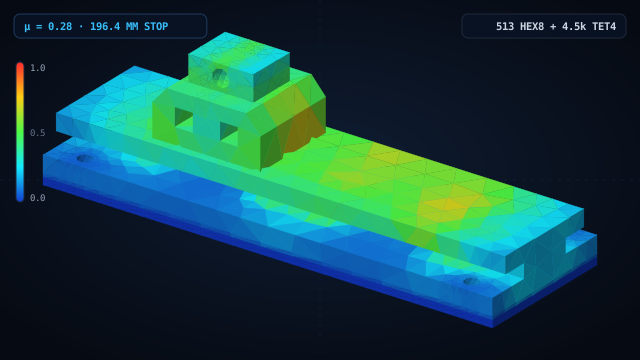
Emergency Braking of Ventilated Caliper Shoe on Rail (transient_friction_brake_shoe_hex)
2-body B-Rep assembly on a conformal 513 HEX8 + 4,546 TET4 mesh with implicit HHT-α Coulomb frictional braking (μ = 0.28) over 220 time steps.
196.4 mm stopping distance (2.29% vs analytical) · 1.15× nose-dive pitch
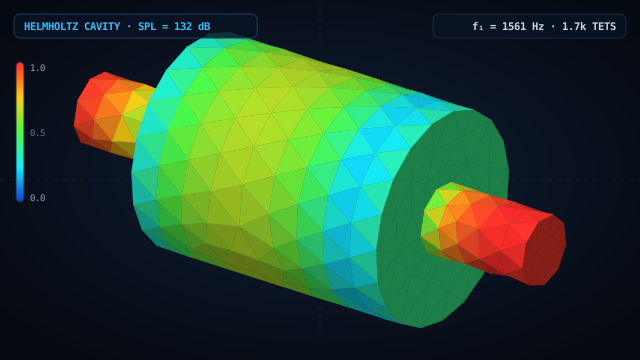
Three-Chamber Reactive Exhaust Muffler Acoustic Cavity (acoustic_muffler_cavity)
3D interior Helmholtz acoustic pressure and sound pressure level (SPL) distribution with transmission loss verification.
p_ac = ±118.5 Pa · SPL & velocity wavefronts