Case Study: Nonlinear Mortar Contact & Lift-Off Threshold on a 5-Solid Conical Valve Seal
66,444-node quadratic P2 TET10 valve assembly under 2,000 N stem preload and back-pressure sweep: 20.95 MPa full 12/12 ring seating, unloading to 8.12 MPa at 2.0 MPa, and lift-off bracketed between 3.20 and 3.30 MPa near analytical p_lift = 3.2481 MPa.
Why Linear Tied Contact Fails for Conical Valve Seals
Most textbook valve analyses bond the poppet cone to the housing seat with tied constraints or linear springs. That shortcut breaks down at the exact engineering question that matters: at what back fluid pressure does the valve actually lose circumferential sealing and lift off?
1. Unilateral compression-only physics: A metal-on-metal 45° conical valve seat transmits compressive bearing force while the poppet is seated, then separates cleanly the instant upward hydraulic force overcomes axial preload. Tied constraints develop artificial tensile "welding" across the cone and never allow blow-by separation.
2. Full 360° circumferential continuity check: Peak contact pressure alone does not prove a seal is leak-tight. You need active compression across all circumferential sectors (12/12 30° bins and 24/24 15° bins) with zero negative nodal contact forces (min F_c = 0).
3. Post-lift-off spring load transfer: Once fluid pressure exceeds the analytical lift-off threshold (p_lift = F_preload / A_disc = 2,000 N / 615.75 mm² = 3.2481 MPa), seat reaction vanishes and the helical spring picks up axial travel and stress.
In this verification benchmark, we solve the complete 5-solid conical poppet valve assembly (`A5_conical_valve_seal_assembly`) in WebCAE using native quadratic P2 TET10 finite elements and unilateral Mortar `frictionless` contact (webcae_solve) — verifying Step 1 seating, Step 2 operating pressure unloading, and a 7-point lift-off pressure sweep spanning 0.00 → 3.50 MPa.
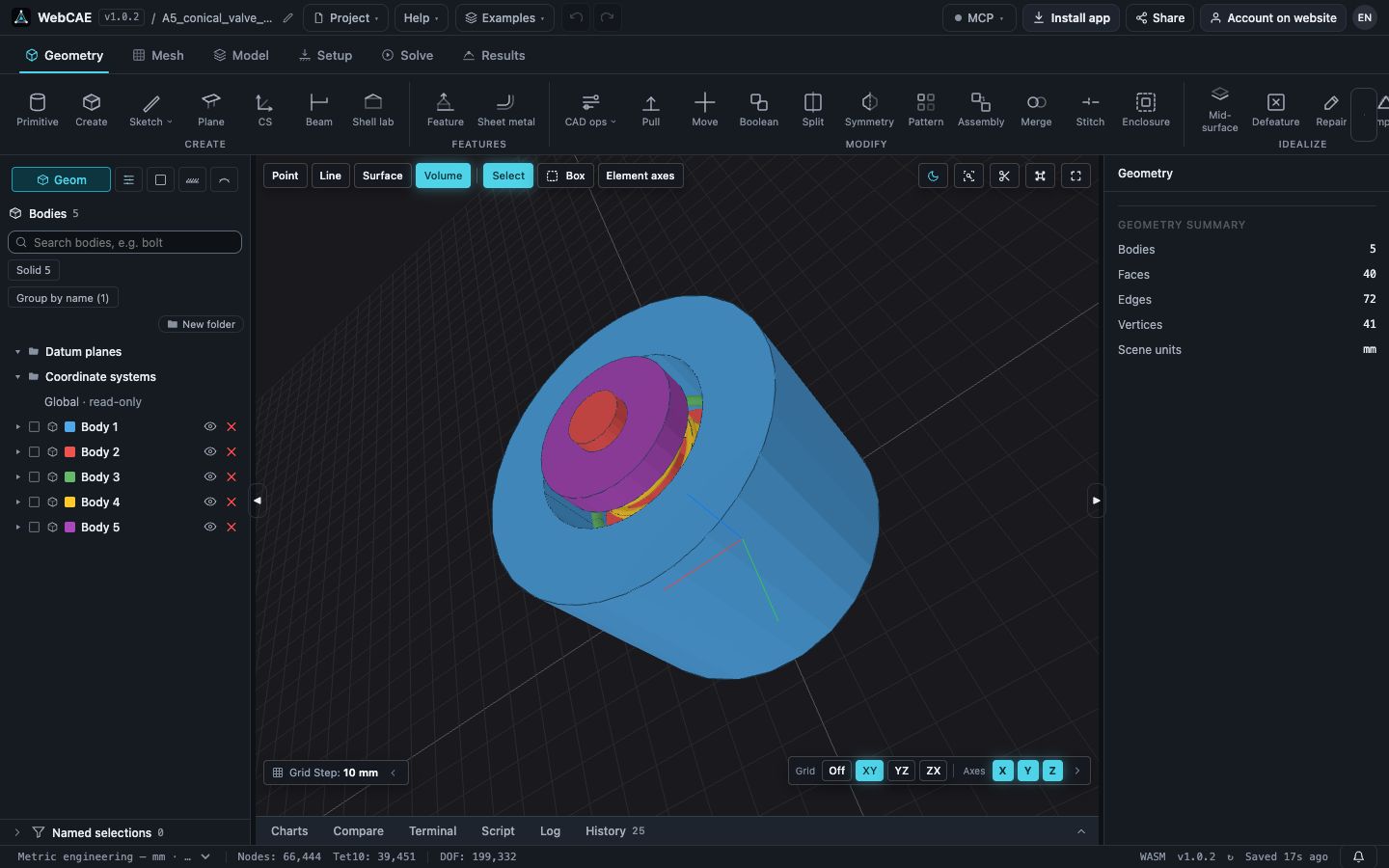
5-Solid Assembly, Quadratic TET10 Mesh & Canonical BCs
The CAD assembly models five interacting bodies along the valve Z-axis (Z = 0..58 mm), combining stiff steel structural parts with a compliant elastomer stem seal:
| Body | Component | Material (E, ν, ρ) | Engineering Role |
|---|---|---|---|
| 1 | valve_body | Stainless Steel (200 GPa, 0.30, 7850 kg/m³) | Fixed housing (Z = 0), internal 45° conical seat (Z = 20..26 mm, R = 14..20 mm) |
| 2 | poppet_stem | Hardened Steel (200 GPa, 0.30, 7850 kg/m³) | Guided poppet disc (R = 14 mm, A_disc = 615.75 mm²) & stem preload target |
| 3 | oring_seal | Elastomer Seal (100 MPa, 0.45, 1200 kg/m³) | Radial gland O-ring sealing stem guide clearance |
| 4 | helical_spring | Spring Steel (200 GPa, 0.30, 7850 kg/m³) | Axial return compliance loaded upon poppet lift-off |
| 5 | spring_retainer | Steel (200 GPa, 0.30, 7850 kg/m³) | Fixed upper spring abutment (Z = 55 mm) |
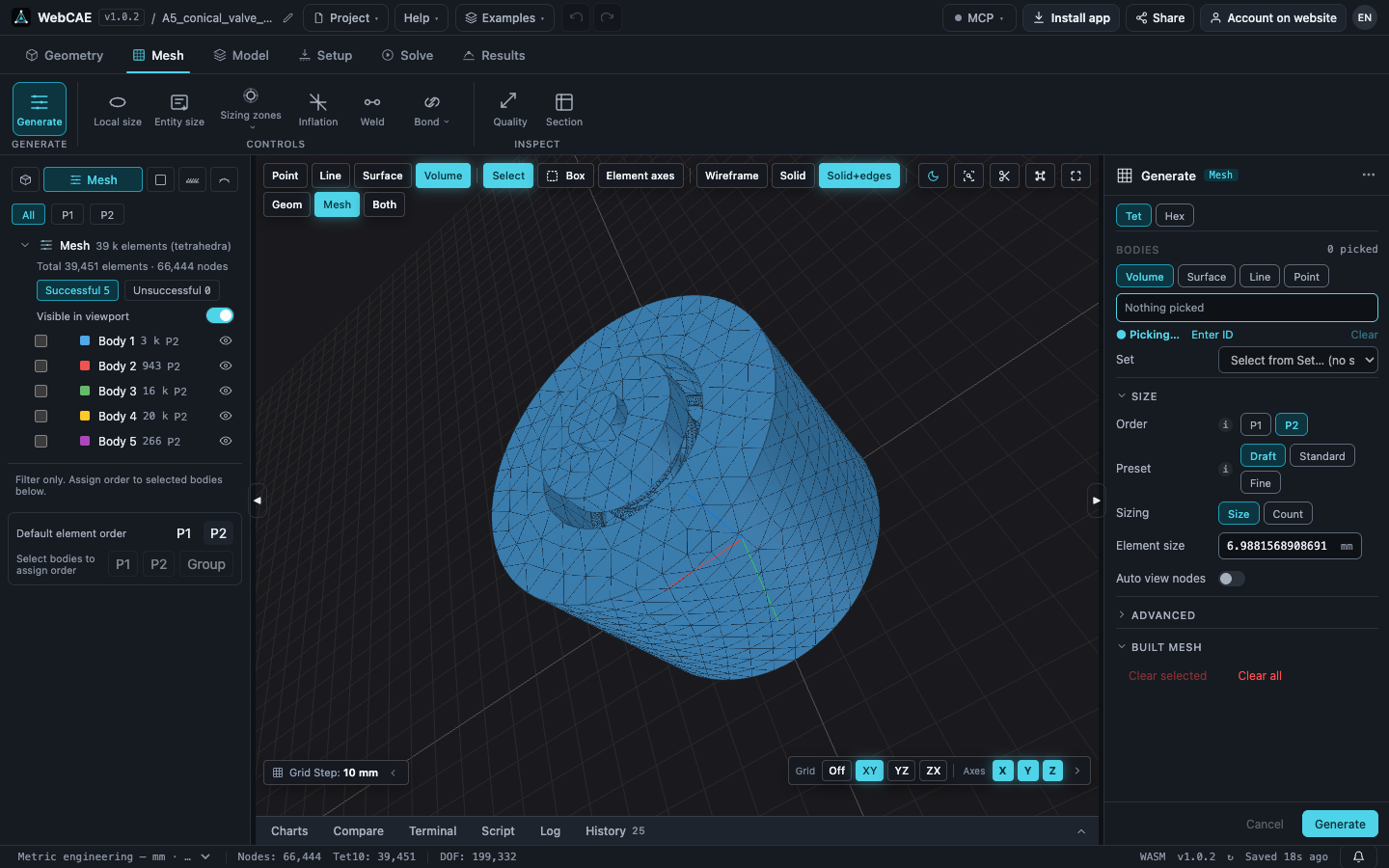
Native P2 TET10 Mesh & Canonical Addressing
- Quadratic mesh (`netgen_tetmesh`):
66,444nodes,39,451quadraticTET10elements,199,332DOFs, `NegJac = 0` (minSICN = 0.0101,avgSICN = 0.3395). - Canonical `surface number N` addressing: Base housing clamp (
surface number 2), spring retainer clamp (surface number 141), stem radial bore guide (fix surface number 36 component=normal), O-ring axial support (surface number 54 component=z), spring centering (surface number 76 component=x/y), downward stem preload-2,000 N(surface number 37), and upward fluid pressure on the poppet disc bottom (surface number 31). - 4 unilateral `contact frictionless` pairs: Poppet cone to housing seat, stem to O-ring, poppet disc shoulder to spring bottom, and spring top to retainer.
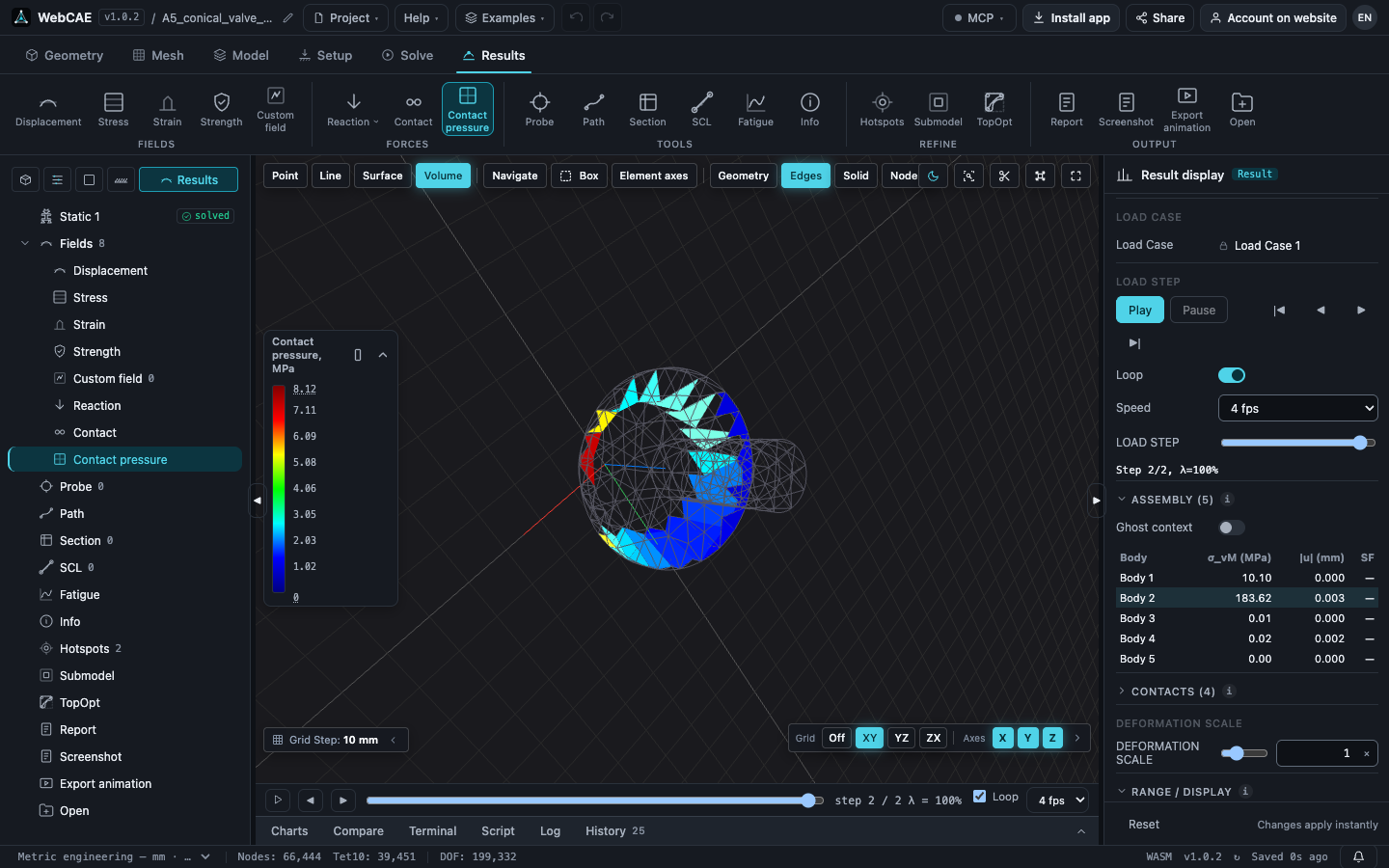
Step 1 Seating (p_back = 0 MPa) vs. Step 2 Operating (p_back = 2.0 MPa)
Isolating Body 2 (poppet_stem) inside WebCAE exposes the 45° conical sealing interface directly across both load steps stored in the interactive .wce bundle:
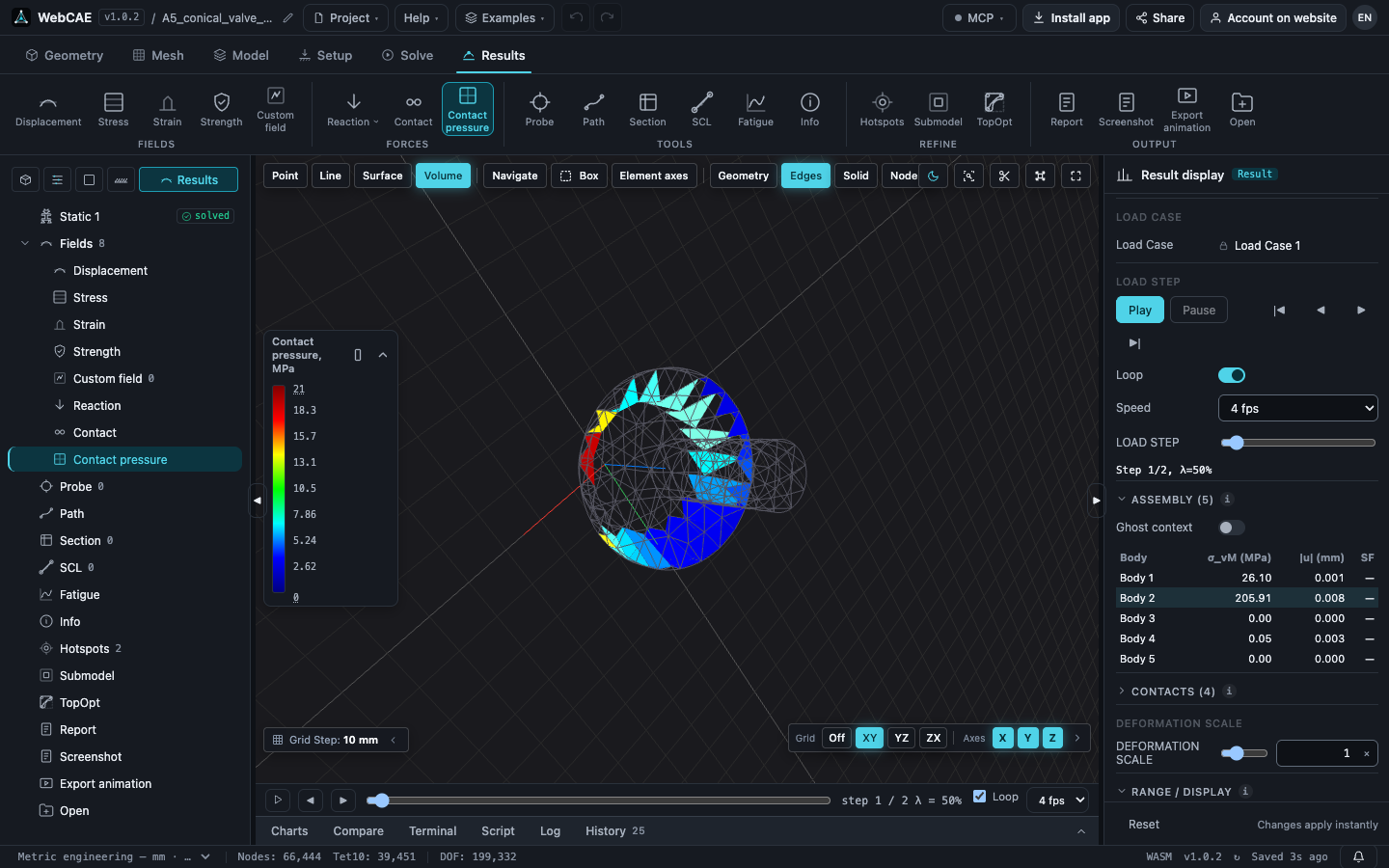
- Step 1 — Stem Preload Seating (`p_back = 0.00 MPa`):
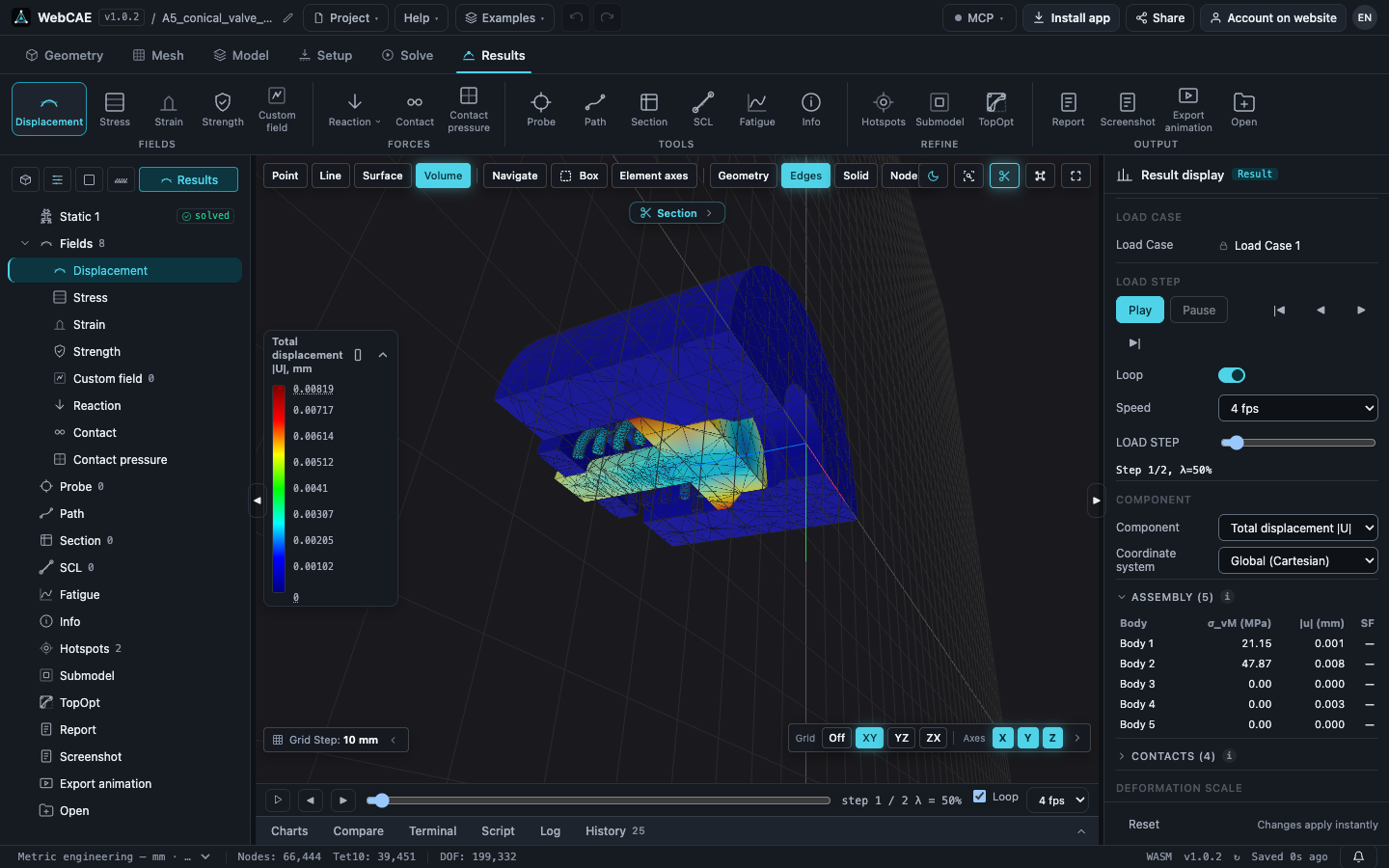
2,000 Ndownward stem force seats the poppet firmly (disc u_z = -0.001443 mm) with `169` active seat nodes covering `12/12` (30°) and `24/24` (15°) sectors ([12,14,8,12,9,9,19,21,20,20,14,11]nodes per 30° bin). Seat contact pressure peaks at `20.954 MPa` (mean2.553 MPa), vertical reaction closes at `R_z = 1,980.92 N` (`0.954%` error), and minimum nodal contact force is `0.0 N`. - Step 2 — Operating Back Pressure (`p_back = 2.00 MPa`): Uniform
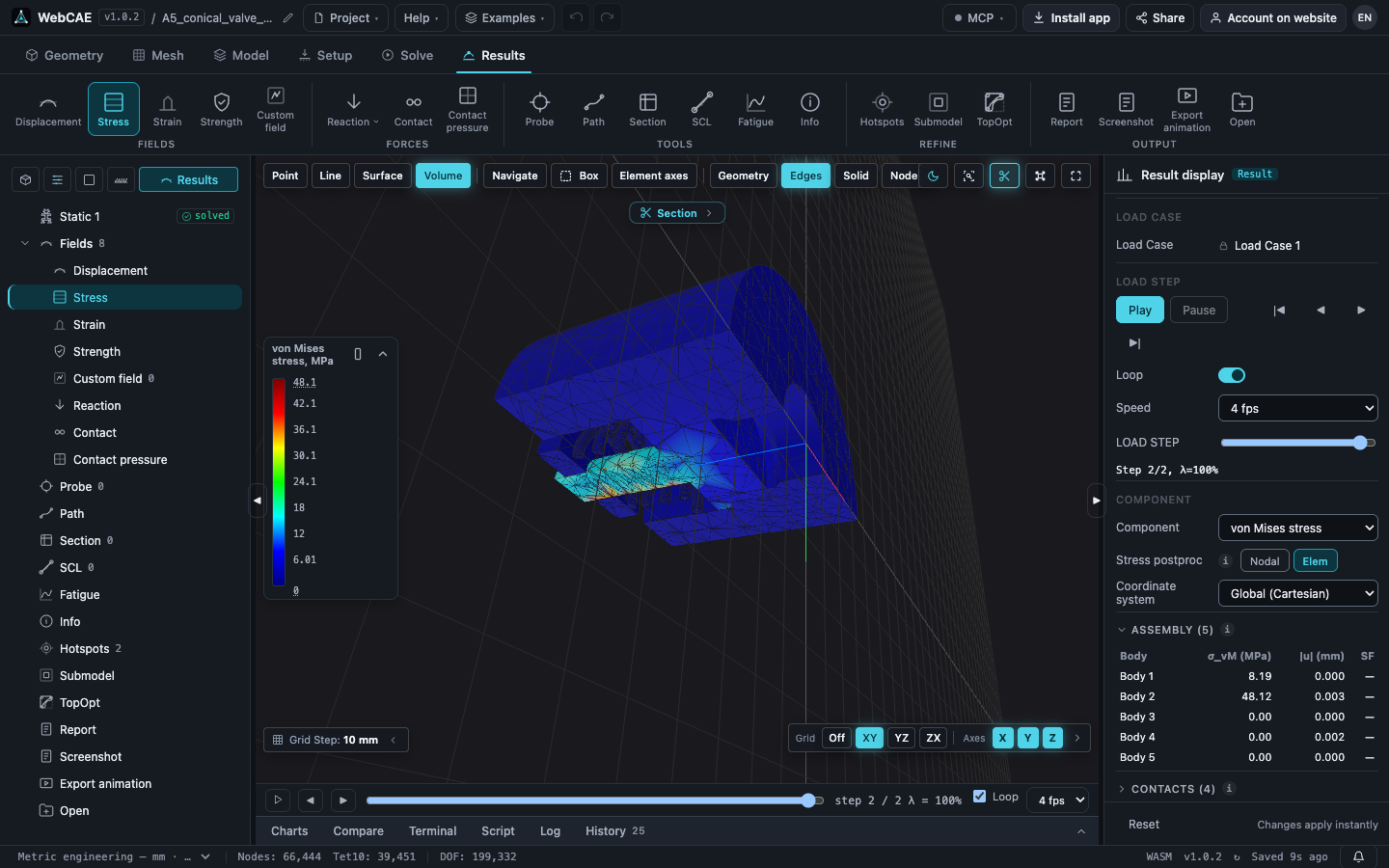
2.0 MPaupward fluid pressure generatesF_up = 1,231.50 N, reducing net closing load to768.50 N. Seat peak contact pressure drops61.2%to `8.122 MPa` (mean1.035 MPa) across `172` active nodes while still holding full `12/12` circumferential continuity (R_z = 760.41 N, `1.053%` error,min F_c = 0.0 N).
Using WebCAE's XZ longitudinal section cut plane with native Elem stress postprocessing confirms `σ_vm max = 48.120 MPa` at Step 2 and seated total deflection `|u|max = 0.008192 mm` at Step 1, synchronized across the 3D canvas, CanvasLegend, and assembly table:
7-Point Lift-Off Pressure Sweep (p_lift = 3.2481 MPa)
To bracket the cracking threshold precisely, we swept back fluid pressure across 7 native `webcae_solve` runs from 0.00 MPa to 3.50 MPa:
p_back (MPa) | F_up (N) | Net F_z (N) | Active Seat Nodes | 30° Sectors | ` | u | max` (mm) | Disc u_z (mm) | σ_vm max (MPa) | R_z Err (%) | min F_c (N) |
|---|---|---|---|---|---|---|---|---|---|---|---|
0.00 | 0.00 | -2,000.00 | 169 | 12/12 | 0.008192 | -0.001443 | 47.866 | 0.954% | 0.0 | ||
1.50 | 923.63 | -1,076.37 | 169 | 12/12 | 0.004380 | -0.000709 | 48.052 | 1.007% | 0.0 | ||
2.00 | 1,231.50 | -768.50 | 172 | 12/12 | 0.003385 | -0.000465 | 48.120 | 1.053% | 0.0 | ||
3.00 | 1,847.26 | -152.74 | 228 | 12/12 | 0.002827 | +0.000022 | 48.815 | 1.889% | 0.0 | ||
3.20 | 1,970.41 | -29.59 | 224 | 12/12 | 0.002729 | +0.000121 | 49.093 | 6.933% | 0.0 | ||
| `3.30` | `2,031.98` | `+31.98` | `14` | `4/12` (OPEN) | `0.382125` | `+0.069393` | `61.809` | 19.103% | `0.0` | ||
| `3.50` | `2,155.13` | `+155.13` | `14` | `4/12` (OPEN) | `0.342822` | `+0.327570` | `292.434` | 21.443% | `0.0` |
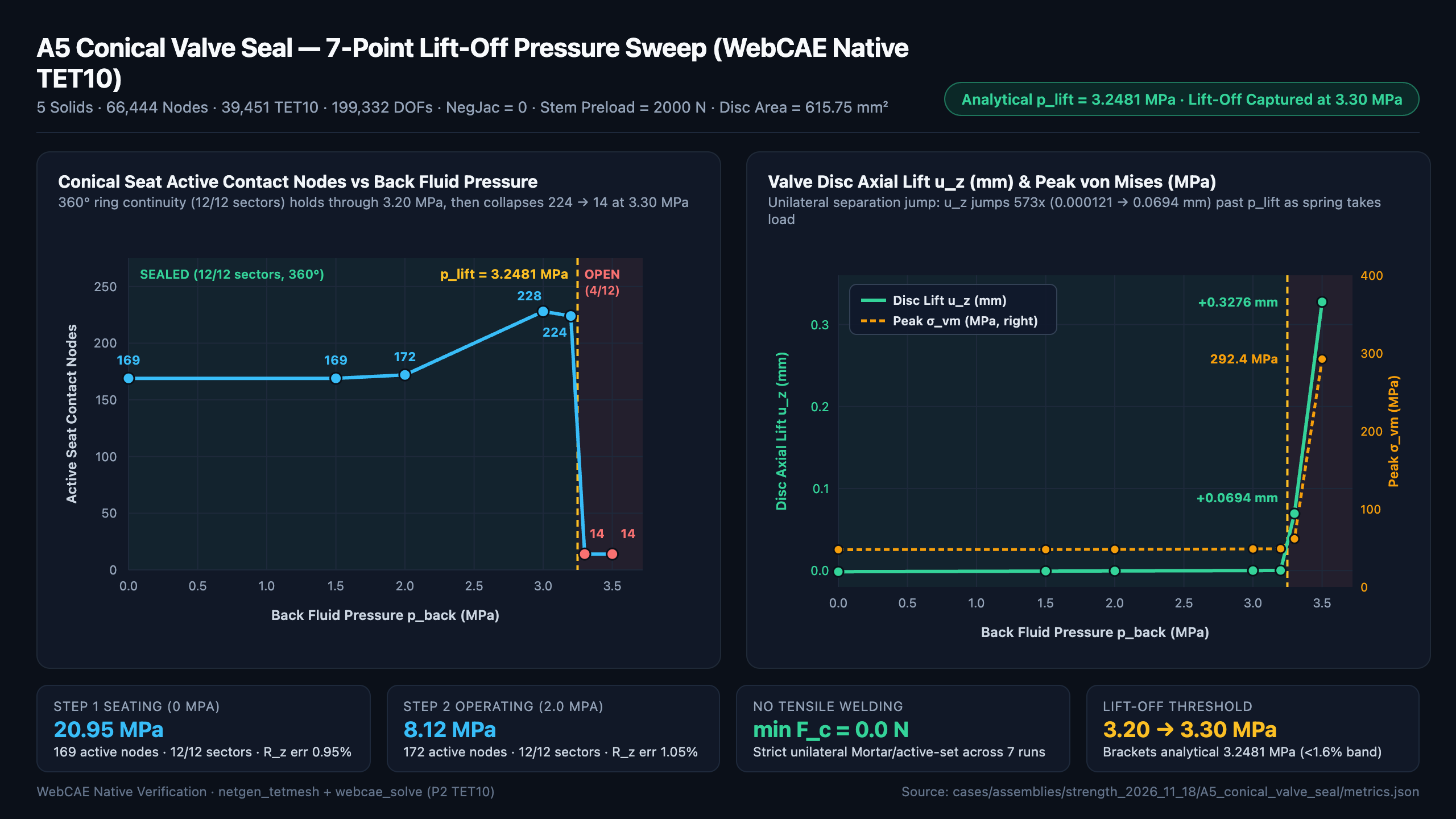
- Exact lift-off capture: Continuous
12/12sealing persists up to3.20 MPa(224active nodes). Crossingp_lift = 3.2481 MPato3.30 MPacollapses active seat nodes `224 → 14` (4/12sectors only), while disc axial lift jumps `573×` (+0.000121 → +0.069393 mm) and reaches+0.327570 mm(σ_vm = 292.434 MPa) at3.50 MPa. *(Post-openingR_zresidual increases on the fixed housing base because the floating poppet transitions onto helical spring stiffness under soft stabilization.)* - Strict non-tensile guarantee: Across all
7pressure points,minContactNodalForceN = 0.0 N— confirming zero numerical tensile adhesion across the conical seal.
Download the Pre-Solved .wce & Canonical .dsl
- Download 2-step solved project: `A5_conical_valve_seal.wce` (3.7 MB)
- Download canonical DSL script: `A5_conical_valve_seal.dsl` (1.3 KB)
Drag A5_conical_valve_seal.wce directly into app.webcae.com to inspect Steps 1–2 in Contact Pressure, isolate Body 2, or slice the assembly with Section Cut Plane (XZ). Join Discord or Telegram to share your own seal and contact benchmarks.