Case Study: Coupled 850 °C Thermal, Thermoelastic & 6-Mode Modal FEA on a Hollow Turbine Blade
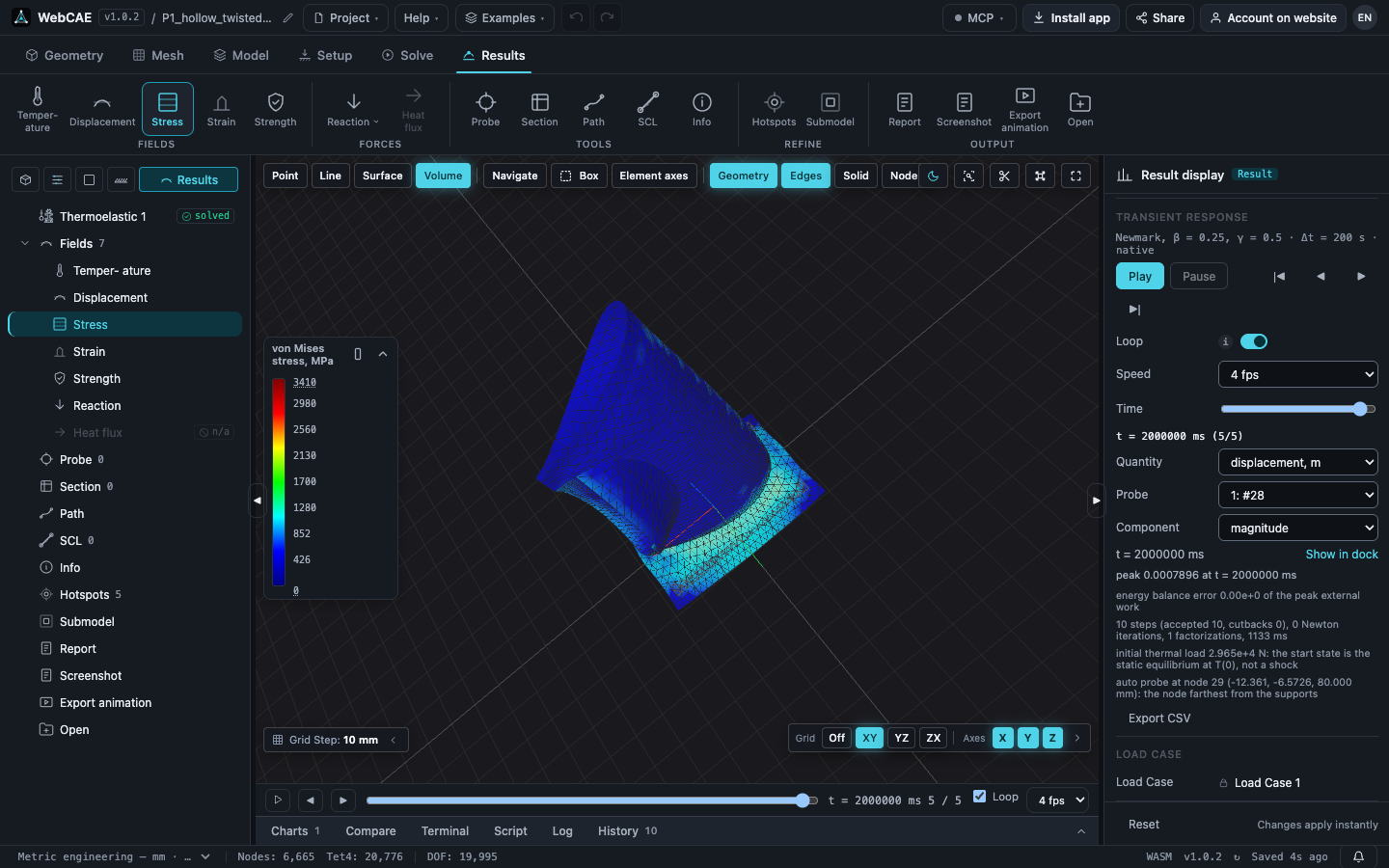
Inconel 718 hollow twisted blade (6,665 nodes, 20,776 TET4, NegJac = 0) under a 500 °C wall gradient: 3,407.2 MPa dovetail root / 1,461.7 MPa trailing-edge stress, 0.8788 mm thermal expansion, and modes f1 = 1,066.4 Hz to f6 = 9,200.3 Hz.
Why Uncoupled Blade Models Miss Real Gas-Turbine Failure Modes
First-stage gas-turbine blades run in one of the harshest coupled multiphysics environments in mechanical engineering: hot combustion gas sweeps the outer airfoil at 850 °C while internal cooling passages hold the inner cavity walls near 350 °C across a 2.4 mm superalloy wall.
Evaluating thermal conductivity, linear static stress, and modal vibration in three disconnected models hides the exact interactions that drive blade fatigue and resonance:
1. Steep through-wall thermal gradients (`ΔT = 500 °C`): Constrained differential expansion between the 850 °C outer airfoil skin and the 350 °C internal cooling passage creates self-equilibrating thermal stresses exceeding 1,460 MPa at the blunted 0.35 mm trailing edge and 3,407 MPa at the fixed dovetail root — even with zero mechanical pressure or centrifugal load applied.
2. Blunt trailing-edge & periodic-seam meshability: Razor-sharp airfoils invert second-order TET10 mid-side nodes. Blunting the trailing edge to 0.55 / 0.35 mm lifts the minimum wedge dihedral angle to 14.641° so Netgen builds a watertight tetrahedral mesh with zero negative Jacobians (`NegJac = 0`).
3. Bending vs. torsion frequency separation: Quantifying the fundamental flapwise bending mode (f1 = 1,066.36 Hz) against the first torsional mode (f2 = 3,323.52 Hz) on the exact same fixed-dovetail mesh verifies stiffness distribution and avoids combustion-wake resonance.
In this case study, we run the full coupled thermal → thermoelastic + 6-mode modal analysis on the Inconel 718 hollow twisted turbine blade (`P1_hollow_twisted_blade`) using WebCAE's native solver (webcae_solve) and canonical surface number N boundary conditions.
Geometry, Inconel 718 Properties & Canonical surface number N Setup
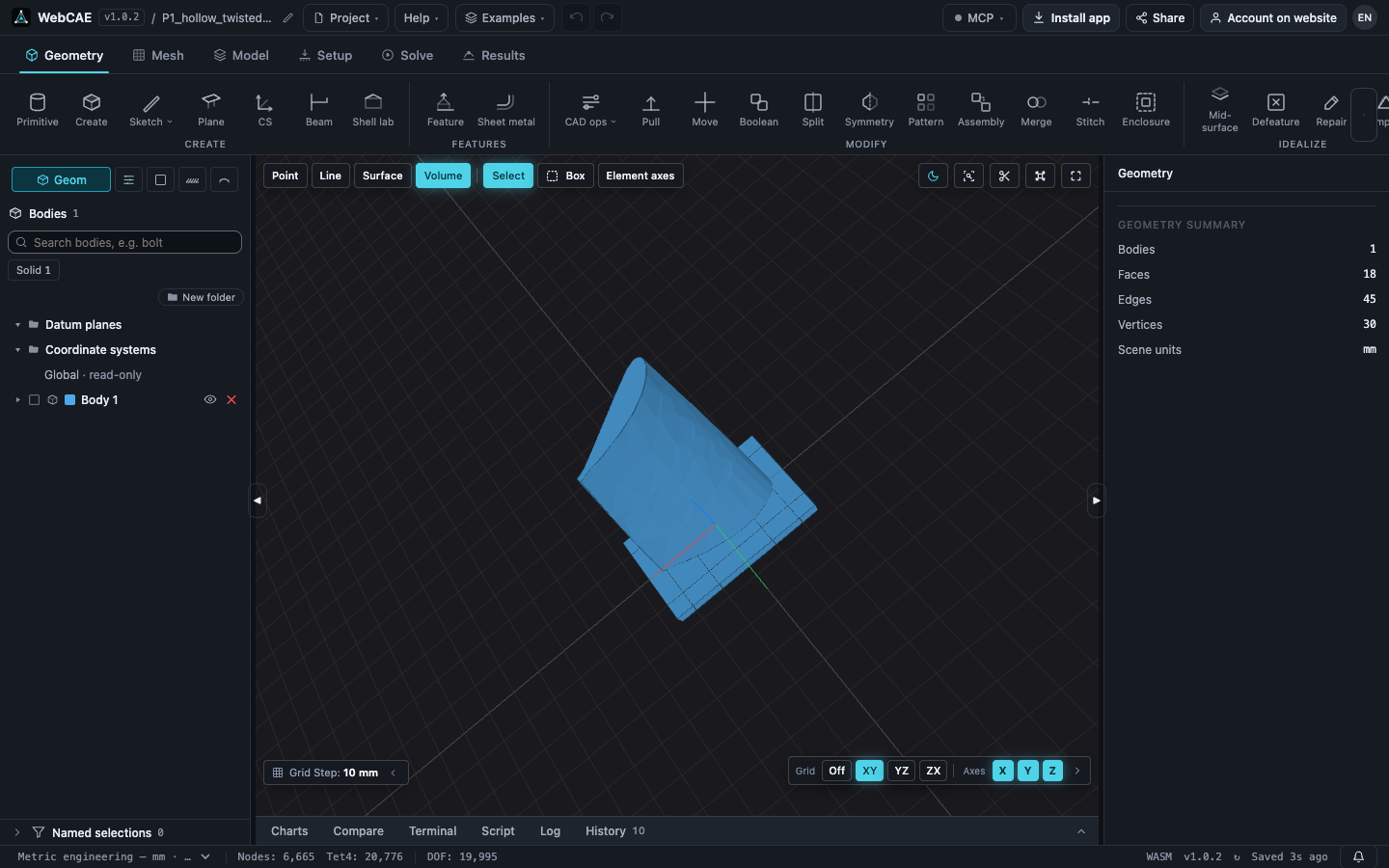
The CAD model (1 solid body, 18 B-Rep faces, 45 edges, 30 vertices, bounding box 52.0 × 30.0 × 98.0 mm, volume 28,612.11 mm³, surface area 17,986.34 mm²) is lofted across 4 spanwise NACA airfoil stations (42 → 28 mm chord, 28° twist) with an internal cooling cavity (2.4 mm wall offset) fused onto a stepped dovetail root (min_edge_len = 0.533 mm, min_face_area = 18.128 mm², min_wedge_angle = 14.641°).
Inconel 718 Material Constants (T_ref = 20 °C)
| Property | Symbol | Value |
|---|---|---|
| Young's modulus | E | 200 GPa |
| Poisson's ratio | ν | 0.30 |
| Density | ρ | 8,190 kg/m³ |
| Thermal conductivity | κ | 18.0 W/(m·K) |
| Specific heat | c_p | 435 J/(kg·K) |
| Thermal expansion | α | 1.4 × 10⁻⁵ 1/K |
Mesh & Canonical Boundary Conditions
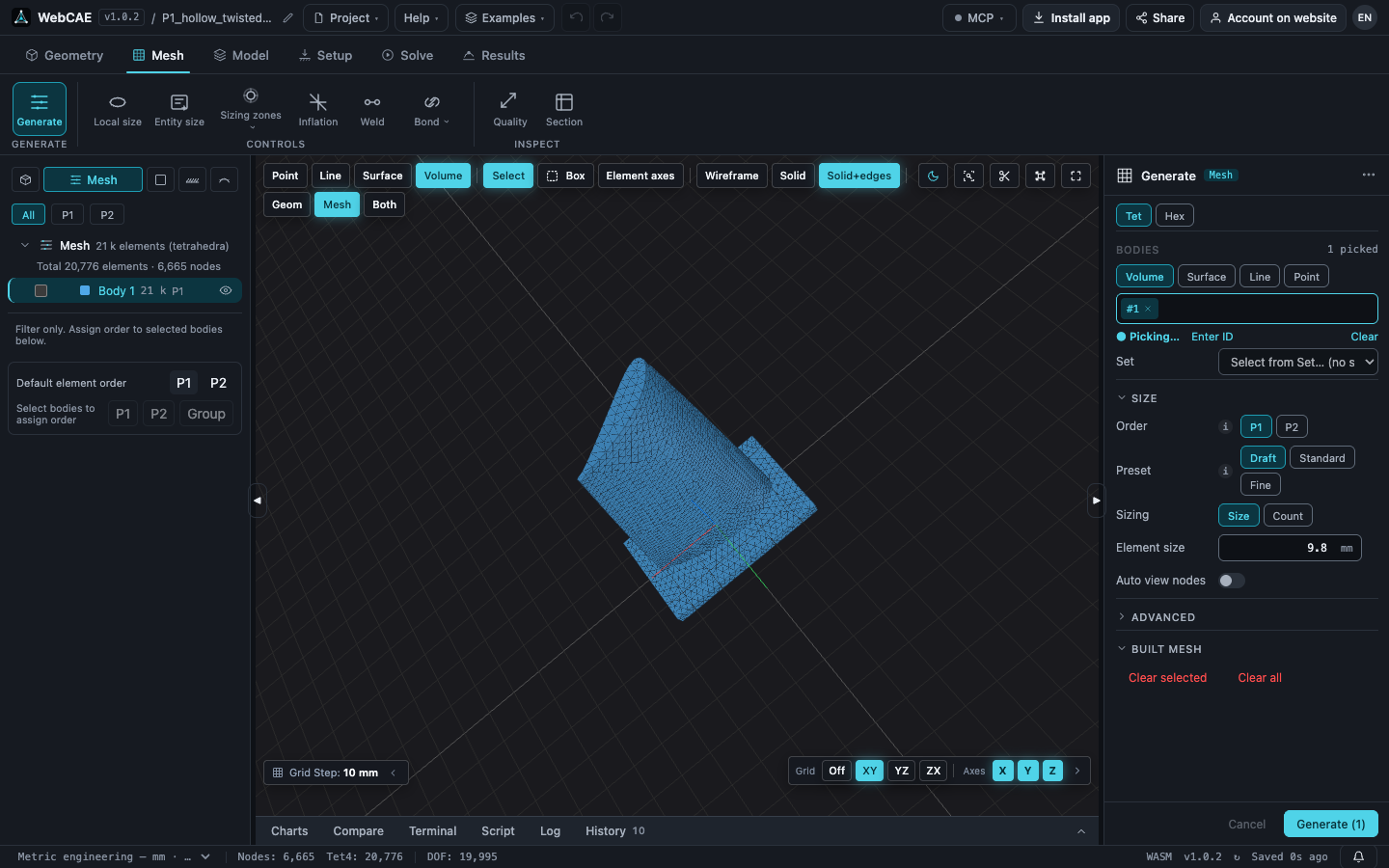
- Native Netgen mesh (`netgen_tetmesh`, `size = 2.0 mm`):
6,665nodes,20,776linearTET4elements,19,995total DOFs (2,298fixed DOFs), `NegJac = 0`,minSICN = 0.04443,avgSICN = 0.59081. - Fixed dovetail supports (`XYZ = 0 mm`): applied explicitly to the dovetail bottom (
surface number 1,z = -18.0 mm) and stepped dovetail flanks (surface number 3,surface number 4,z = -11.5 mm,area = 715.35 mm²each). - Outer airfoil gas temperature (`T = 850 °C`):
surface number 15,surface number 16,surface number 17,surface number 18. - Internal cooling cavity (`T = 350 °C`):
surface number 6,surface number 7,surface number 8,surface number 14. - Dovetail bottom convection (`h = 500 W/(m²·K)`, `T_∞ = 250 °C`):
surface number 1.
Coupled Thermal & Thermoelastic Results (webcae_solve Native)
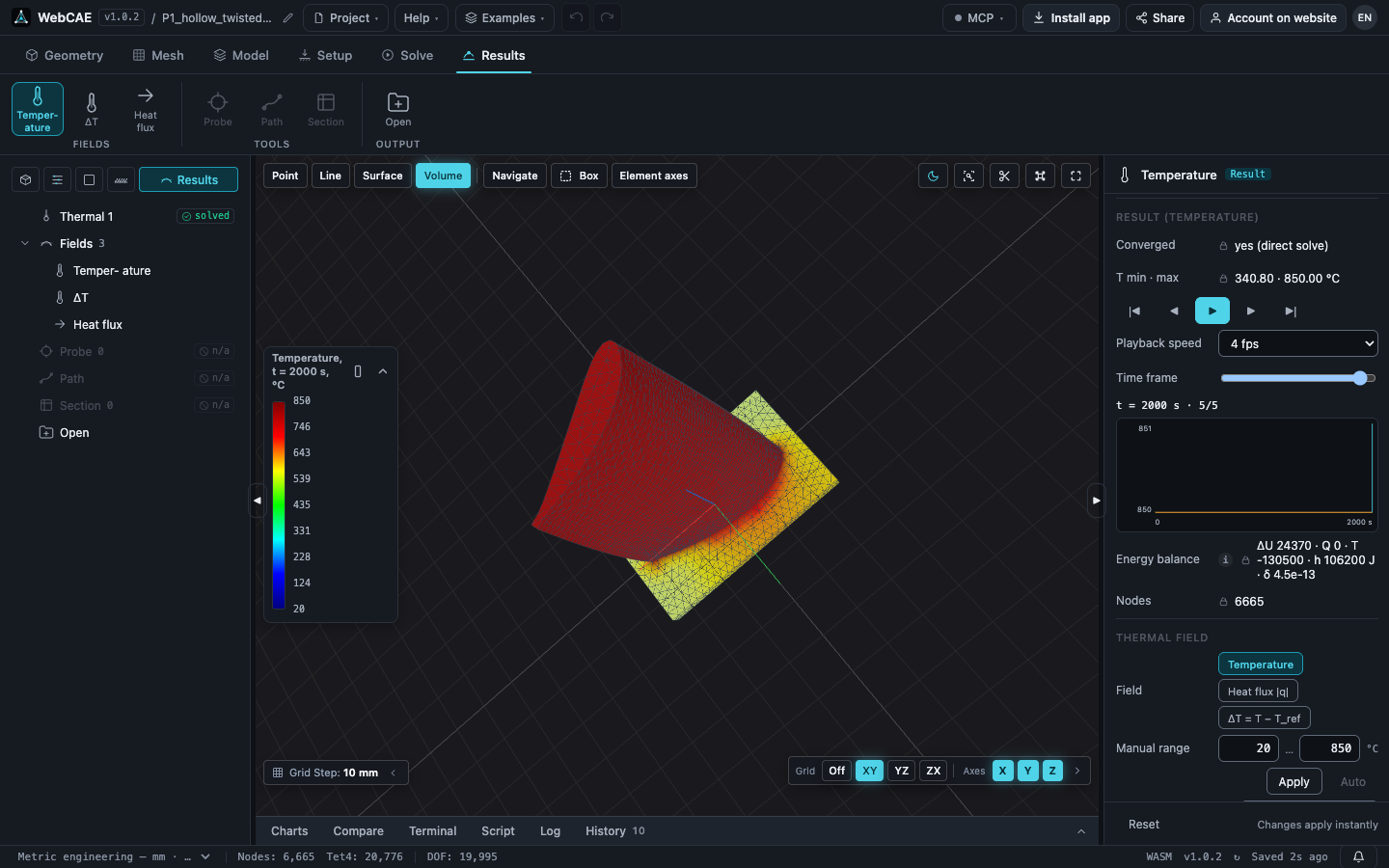
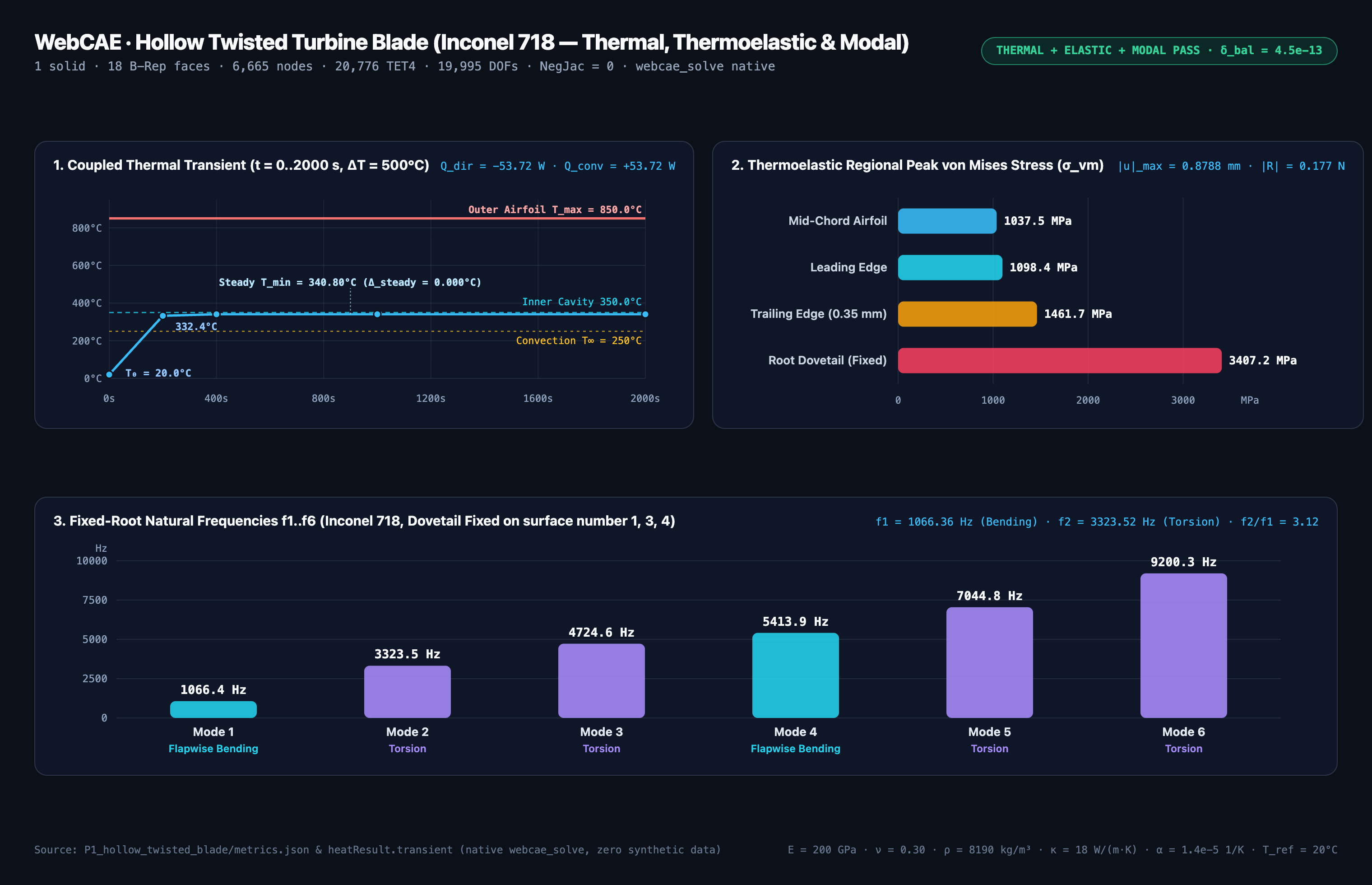
A quasistatic thermoelastic transient march (dt = 200 s, t_end = 2,000 s, θ = 1, T_0 = 20 °C) was cross-checked directly against a standalone steady-state solve thermal run on the same mesh:
Thermal & Thermoelastic Verification Table
| Quantity | Measured Value | Notes / Verification Gate | ||
|---|---|---|---|---|
Domain temperature T_min .. T_max | 340.80 .. 850.00 °C | T_min occurs on convection root surface number 1 | ||
Airfoil through-wall ΔT | 500.00 °C | 350.00 °C inner cavity to 850.00 °C outer skin | ||
| Steady vs. transient steady-state diff | 0.000000 °C | Exact convergence by t = 2,000 s (332.41 °C at 200 s) | ||
| Steady heat energy balance | Q_dir = -53.72 W, Q_conv = +53.72 W | Transient relative balance error 4.47 × 10⁻¹³ | ||
| Peak displacement ` | u | _max` | 0.8788 mm (0.878775 mm) | Thermal expansion growth along twisted span |
| Thermal load self-equilibrium residual | Fx = -1.14e-11, Fy = 3.05e-8, Fz = 1.35e-9 N | Machine-precision internal force balance | ||
Fixed-root net reaction (Rx, Ry, Rz) | (0.0041, -0.0550, -0.1678) N | Net ` | R | = 0.177 N` under pure thermal loading |
Mid-chord airfoil peak σ_vm | 1,037.47 MPa | Constrained shell-like through-wall thermal bending | ||
Leading edge peak σ_vm | 1,098.37 MPa | Steep curvature gradient near cooling passage | ||
Trailing edge peak σ_vm | 1,461.71 MPa | Thin 0.35 mm blunted trailing edge | ||
Fixed dovetail root peak σ_vm | 3,407.15 MPa | Linear-elastic stress at fixed 20 °C → 340.8 °C root |
Engineering insight: In linear thermoelasticity withΔT = 320–830 °Crelative toT_ref = 20 °C, fully clamping the dovetail flanks against thermal expansion produces a sharp local linear-elastic stress spike (3,407.15 MPa) at the constraint boundary — signaling where real turbomachinery designs introduce compliant fir-tree clearances or elastoplastic creep-fatigue assessment.
Fixed-Root Modal Spectrum (f1..f6)
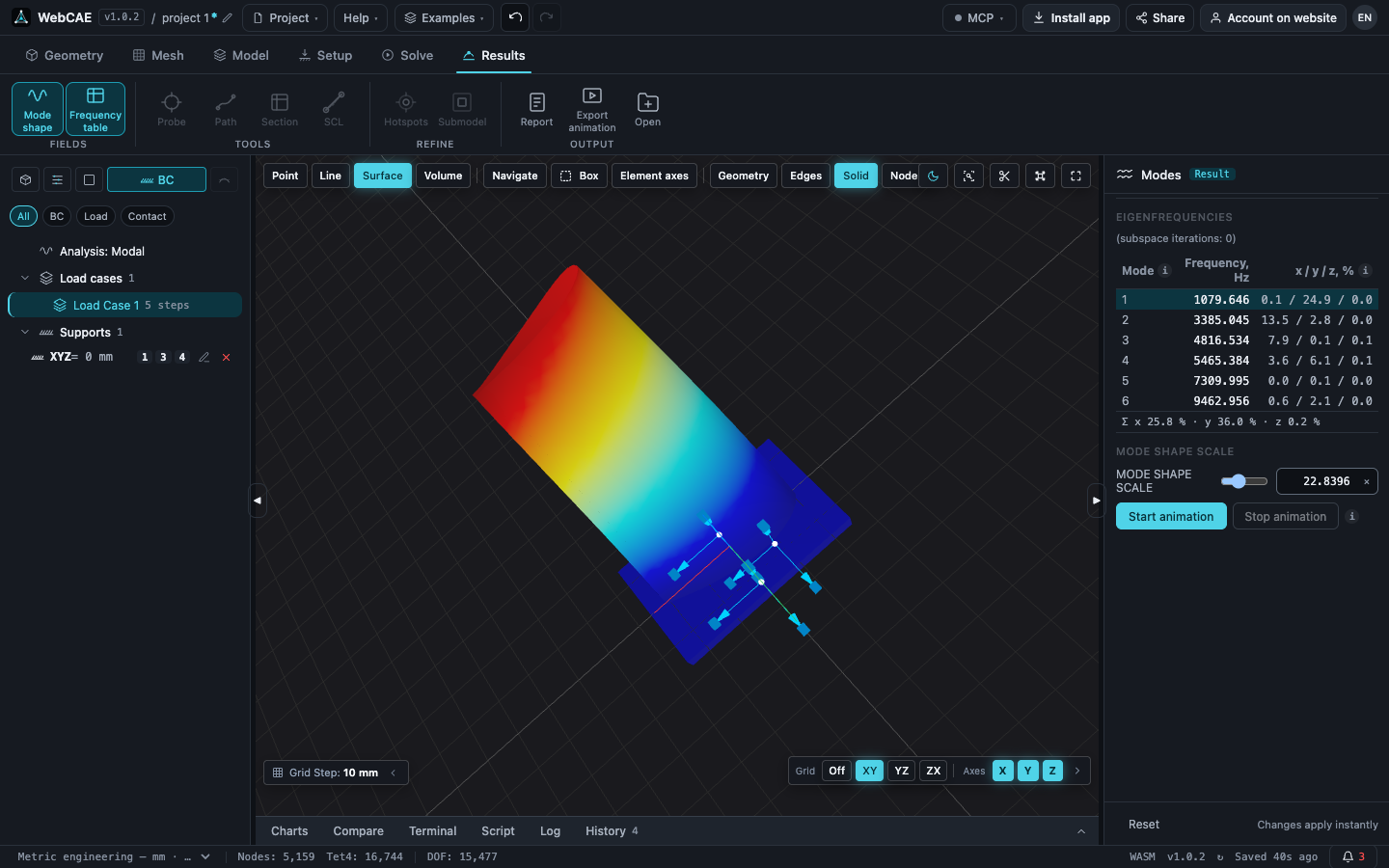
Solving the undamped eigenvalue problem on the exact same 6,665-node mesh and dovetail constraint set (surface number 1, 3, 4) yields the first six natural frequencies and tip-displacement mode classifications:
| Mode | Frequency (Hz) | Classification | Tip RMS (ux, uy, uz) |
|---|---|---|---|
| 1 | 1,066.364 | Flapwise Bending | (0.06749, 0.8161, 0.05338) |
| 2 | 3,323.524 | Torsion | (0.6695, 0.3475, 0.07251) |
| 3 | 4,724.599 | Torsion | (0.3771, 0.4288, 0.09420) |
| 4 | 5,413.873 | Flapwise Bending | (0.1821, 0.4382, 0.07178) |
| 5 | 7,044.757 | Torsion | (0.04991, 0.07862, 0.02149) |
| 6 | 9,200.279 | Torsion | (0.1681, 0.2396, 0.06748) |
Download the Pre-Solved .wce Project & Inspect in WebCAE
The solved thermoelastic + transient thermal project file bundles the 6,665-node mesh, canonical surface number N boundary conditions, 5 transient frames (t = 0..2,000 s), temperature field, displacement field, and von Mises stress field:
Open app.webcae.com, drag and drop P1_hollow_twisted_blade.wce, and toggle between Stress, Displacement, and Temperature (switching Analysis to Thermal) or run Modal directly in your browser. Questions or turbomachinery assemblies of your own? Join us on Discord or Telegram.