Case Study: 8-Step Nonlinear Mortar Contact on a 20-Part Planetary Gearbox in WebCAE
How WebCAE solves a 20-solid planetary stage across 8 orbital rotation steps with 6 Mortar frictionless gear pairs, K_γ = 1.0007–1.0094 load sharing, torque balance within [-2.58%, +1.25%], and separated rigid/elastic displacement.
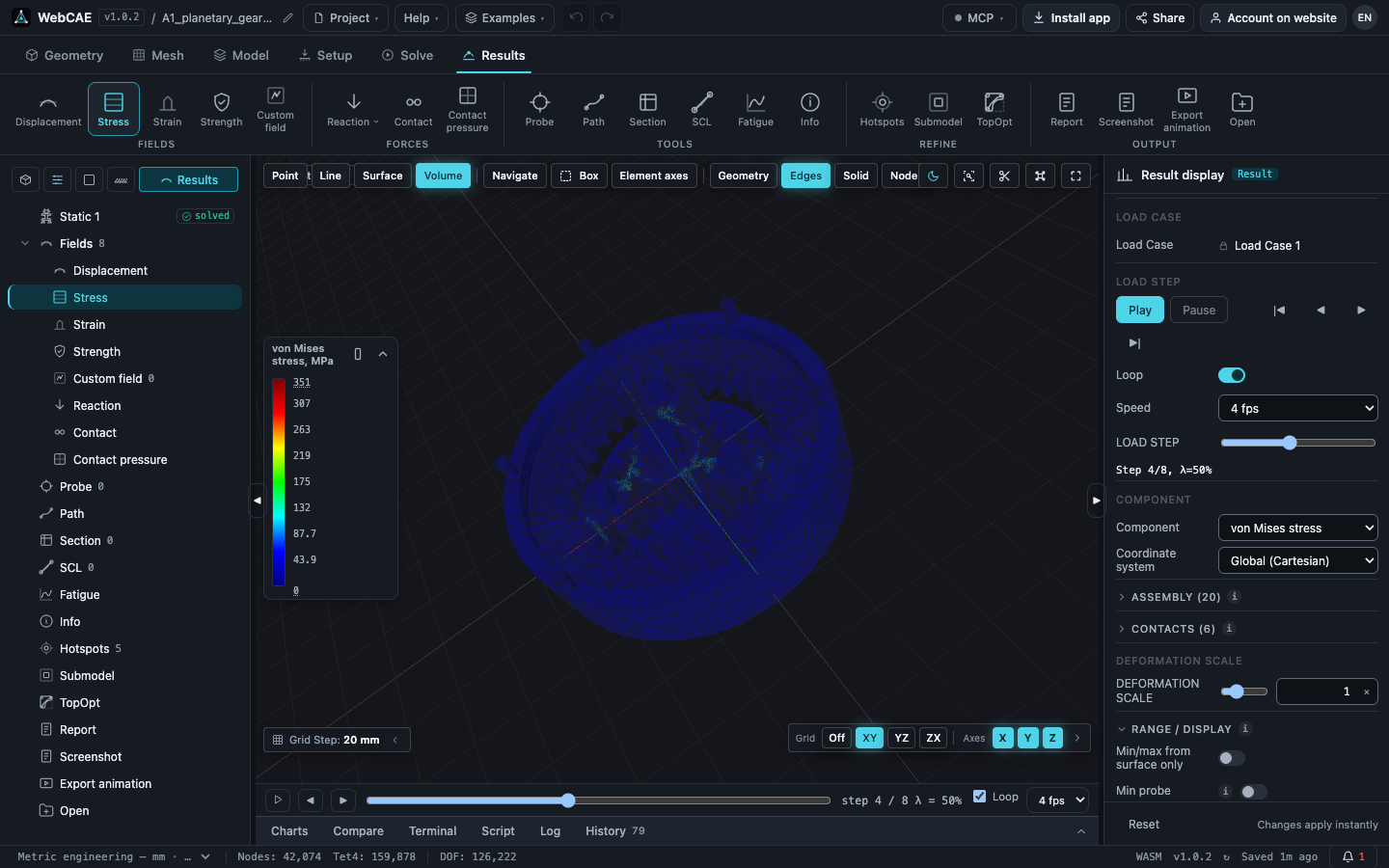
Why Static Single-Snapshot Gear FEA Misses Real Mesh Physics
Most finite-element tutorials on gears mesh a single tooth pair, glue the contact surfaces with linear tied constraints, and check static bending stress at one arbitrary angle. That misses the two phenomena that actually govern planetary gearbox life:
1. Unilateral contact separation & single-to-double tooth load sharing: Involute flanks can only push in compression — they cannot pull in tension. As the sun gear rotates through an active meshing cycle, contact periodically shifts between two shared tooth pairs and a single tooth pair, spiking local contact pressure and tooth-root von Mises stress.
2. Rigid orbital motion vs. small elastic deformation: In a planetary stage, all three planets orbit with the carrier while spinning around their own pins. If a solver mixes rigid-body rotation into the displacement field, strain recovery and visualization become unusable unless the postprocessor cleanly separates rigidDisplacement from elastic displacement.
In this case study, we solve the full 20-part planetary gearbox assembly (`A1_planetary_gearbox_20part`) across 8 orbital rotation steps using WebCAE's native nonlinear Mortar `frictionless` contact solver (webcae_solve) — with zero tied approximations on the gear teeth, zero negative-Jacobian elements, and verified torque balance at every single step.
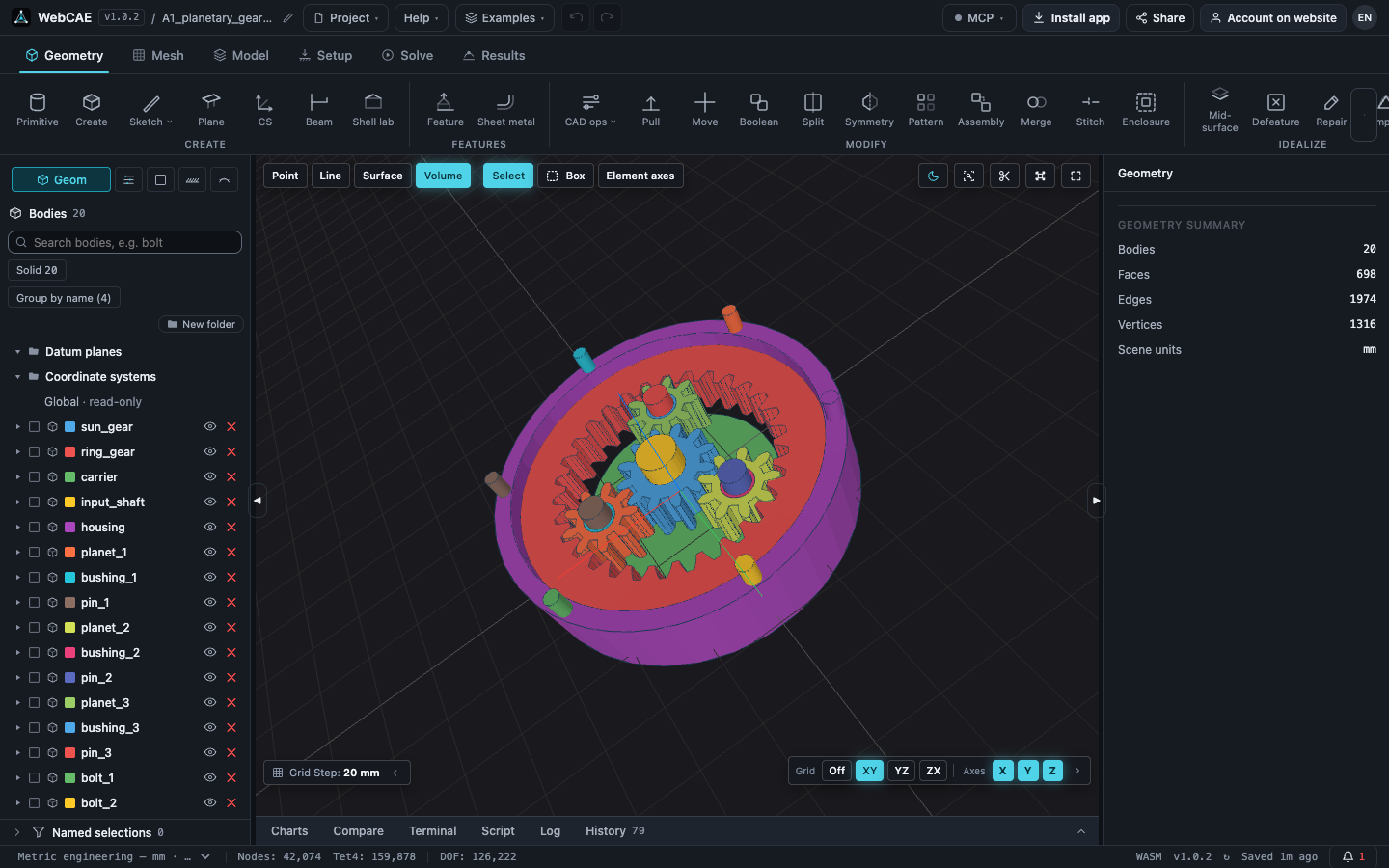
Model Architecture: 20 Solids, 6 Mortar Contact Pairs & Canonical Addressing
The assembly spans 20 solid bodies (698 B-Rep faces) representing a complete planetary reduction stage with module m = 2.5 mm, pressure angle α = 22°, sun tooth count z_s = 12, three planets z_p = 9, and internal ring z_r = 30 (base radii r_b,sun = 13.9078 mm, r_b,ring = 34.7694 mm, orbit radius r_orbit = 26.25 mm, theoretical torque ratio T_ring / T_sun = z_r / z_s = 2.50):
| Component Group | Bodies | Material (E, ν, ρ) | Target Mesh Size |
|---|---|---|---|
| Sun gear, ring gear & 3 planets | 5 | Alloy gear steel (210 GPa, 0.29, 7850 kg/m³) | 1.0–1.5 mm |
| Planet carrier & housing | 2 | Structural steel (200 GPa, 0.29, 7850 kg/m³) | 4.0 mm |
| Input shaft, 3 pins & 6 bolts | 10 | Shaft/fastener steel (206 GPa, 0.29, 7850 kg/m³) | 2.5–4.0 mm |
| 3 planet bronze bushings | 3 | Bearing bronze (115 GPa, 0.34, 8800 kg/m³) | 2.5 mm |
Mesh & Boundary Condition Setup
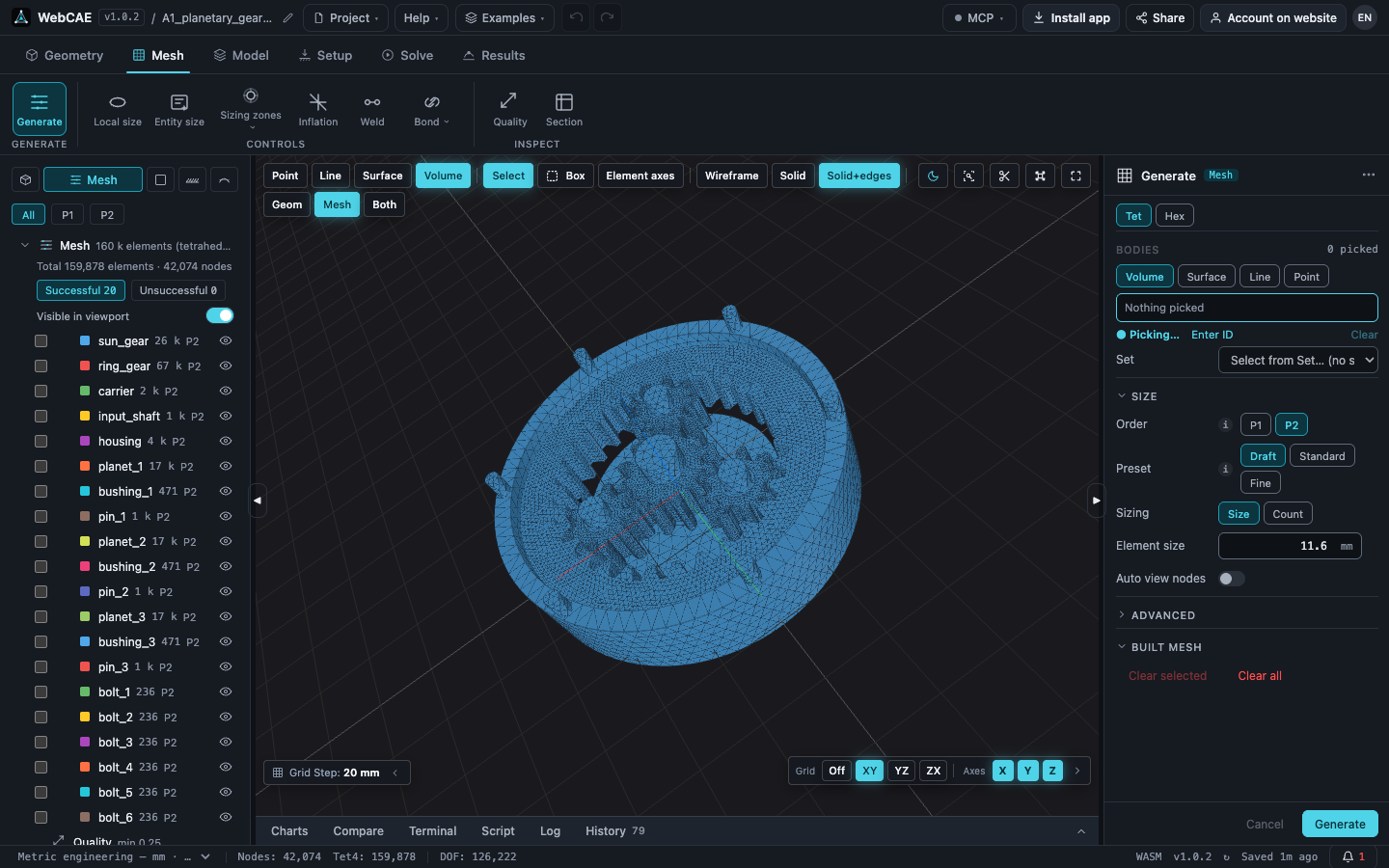
- Multi-body mesh (`netgen_tetmesh`):
42,074nodes,159,878linearTET4elements,126,222DOFs, `NegJac = 0`. All three planets share identical120°rotationally symmetric tooth meshes to eliminate artificial meshing bias across branches. - Canonical face addressing: Every boundary condition targets an explicit model-tree
surface number Nfrom WebCAE's topology journal — no bounding-box heuristics or axis fallbacks. - Statically determinate supports: Ring outer cylinder (
surface number 729), carrier bore (surface number 2179), and housing outer face (surface number 2217) are fixed. Rotating cylindrical bores and thrust faces usecomponent=normalandcomponent=zconstraints (surface number 121,122,2209,2211, etc.), permitting free kinematic rotation without artificial tangential grounding. - Pure torque loading:
T_in = 60.0 N·mis applied as a pure tangential nodal couple on the sun gear front annulus (surface number 123) with zero net radial force (∑F = 0,M_z = 60.0 N·m). - 6 Mortar unilateral contact pairs:
contact body6 body1 frictionless,body9 body1,body12 body1(planet–sun) andbody6 body2,body9 body2,body12 body2(planet–ring) with calibrated pre-engagement clearancegn = -0.004 mm.
Multi-Step Mortar Results: Single-vs-Double Tooth Mesh Transition
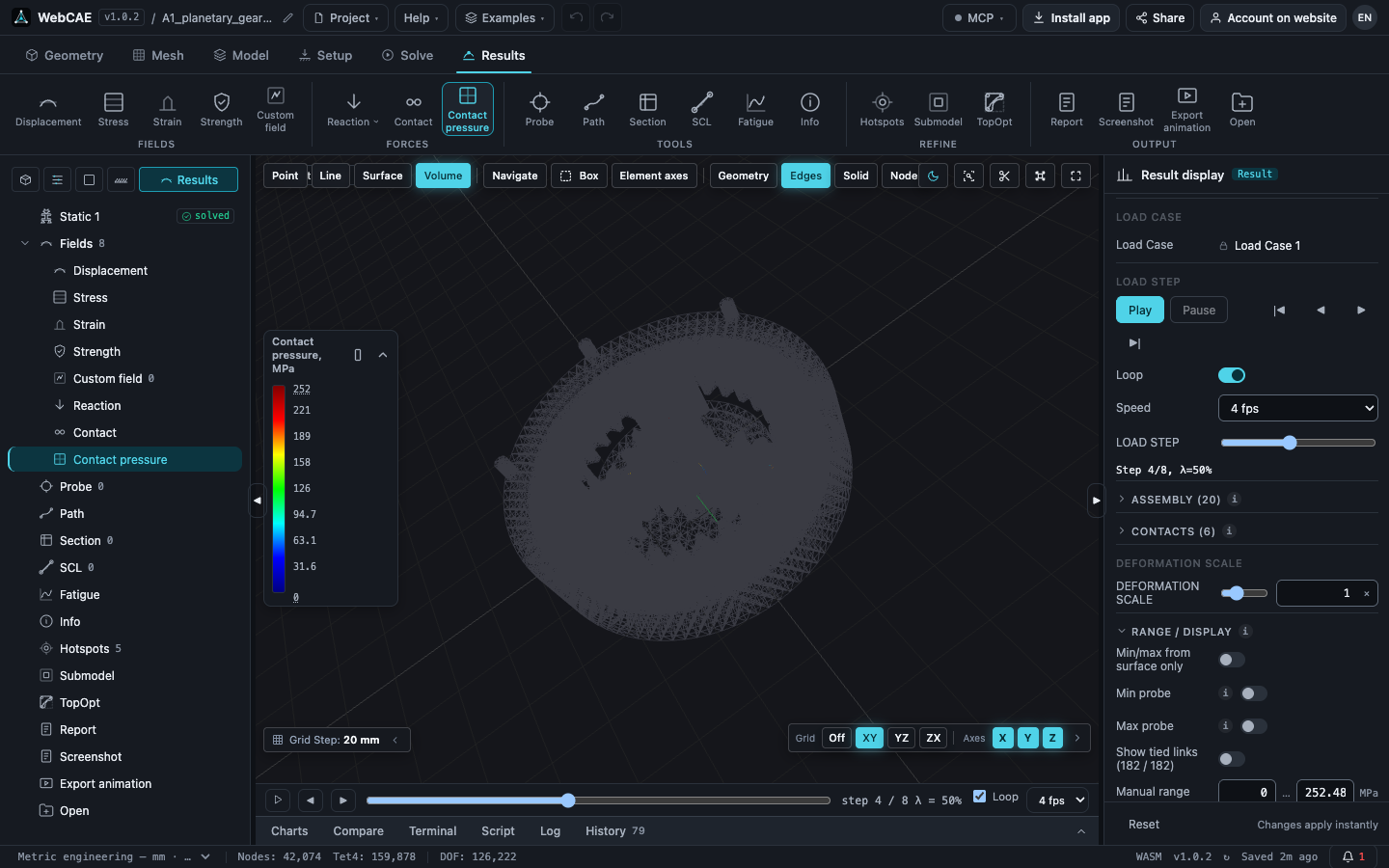
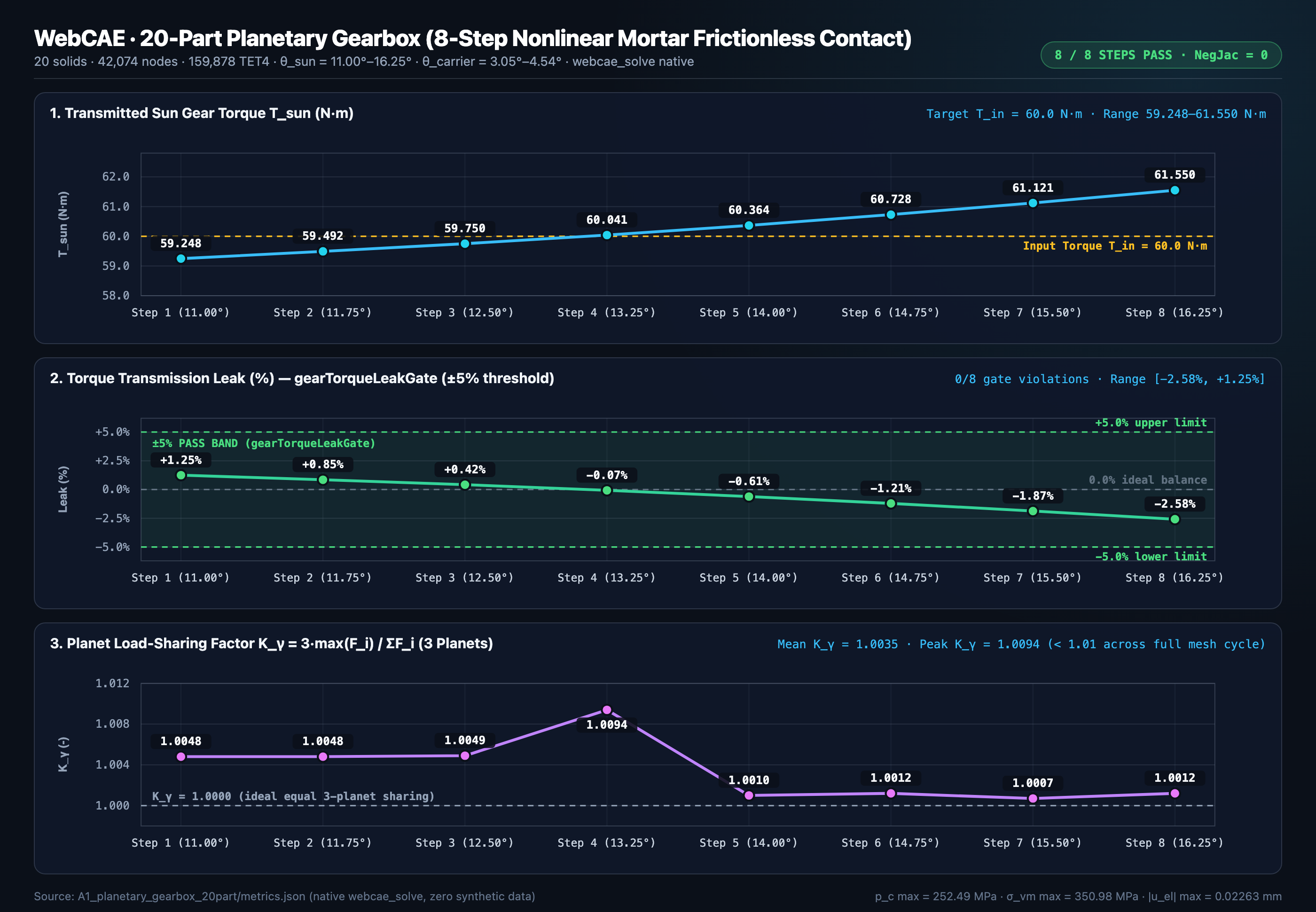
All 8 orbital rotation steps (θ_sun = 11.00°..16.25°, θ_carrier = 3.0515°..4.5383°, θ_planet_rel = -10.6012°..-15.6149°) converged cleanly in native webcae_solve with zero tensile contact forces (minFc = 0):
| Step | θ_sun (°) | θ_carrier (°) | ` | u_el | max` (mm) | σ_vm max (MPa) | p_c max (MPa) | Active Nodes | T_sun (N·m) | T_ring (N·m) | Leak (%) | K_γ |
|---|---|---|---|---|---|---|---|---|---|---|---|---|
| 1 | 11.00 | 3.0515 | 0.02150 | 234.36 | 241.42 | 213 | 59.248 | 153.355 | +1.25% | 1.0048 | ||
| 2 | 11.75 | 3.2689 | 0.02130 | 227.68 | 241.38 | 210 | 59.492 | 152.928 | +0.85% | 1.0048 | ||
| 3 | 12.50 | 3.4856 | 0.02118 | 221.93 | 241.63 | 213 | 59.750 | 152.784 | +0.42% | 1.0049 | ||
| 4 | 13.25 | 3.7014 | 0.02263 | 350.98 | 252.49 | 189 | 60.041 | 149.835 | -0.07% | 1.0094 | ||
| 5 | 14.00 | 3.9131 | 0.02258 | 341.66 | 249.26 | 189 | 60.364 | 151.410 | -0.61% | 1.0010 | ||
| 6 | 14.75 | 4.1224 | 0.02205 | 331.98 | 243.77 | 189 | 60.728 | 151.311 | -1.21% | 1.0012 | ||
| 7 | 15.50 | 4.3308 | 0.02196 | 330.29 | 246.19 | 189 | 61.121 | 151.829 | -1.87% | 1.0007 | ||
| 8 | 16.25 | 4.5383 | 0.02156 | 315.50 | 248.07 | 197 | 61.550 | 152.909 | -2.58% | 1.0012 |
Three physical highlights from the 8-step run
1. Single-tooth contact transition at Step 4: From Step 3 to Step 4 (θ_sun = 12.50° → 13.25°), active contact nodes drop from 213 to 189 as the load shifts onto a narrower single-pair tooth engagement zone. Peak contact pressure rises from 241.63 to 252.49 MPa, and planet tooth-root von Mises stress jumps from 221.93 to 350.98 MPa.
2. Verified torque balance (`gearTorqueLeakGate` `0/8` violations): Transmitted sun torque T_sun tracks the 60.0 N·m input within `[-2.58%, +1.25%]` (well inside the ±5% engineering gate), while ring reaction torque averages 152.0 N·m (149.835–153.355 N·m, T_ring / T_sun ≈ 2.50 = z_r / z_s).
3. Near-ideal 3-planet load sharing: The planet load-sharing factor K_γ = 3·max(F_i) / ΣF_i stays between `1.0007` and `1.0094` (mean 1.0035), confirming balanced engagement across all three planets.
Separating Rigid Orbital Rotation from Elastic Deformation
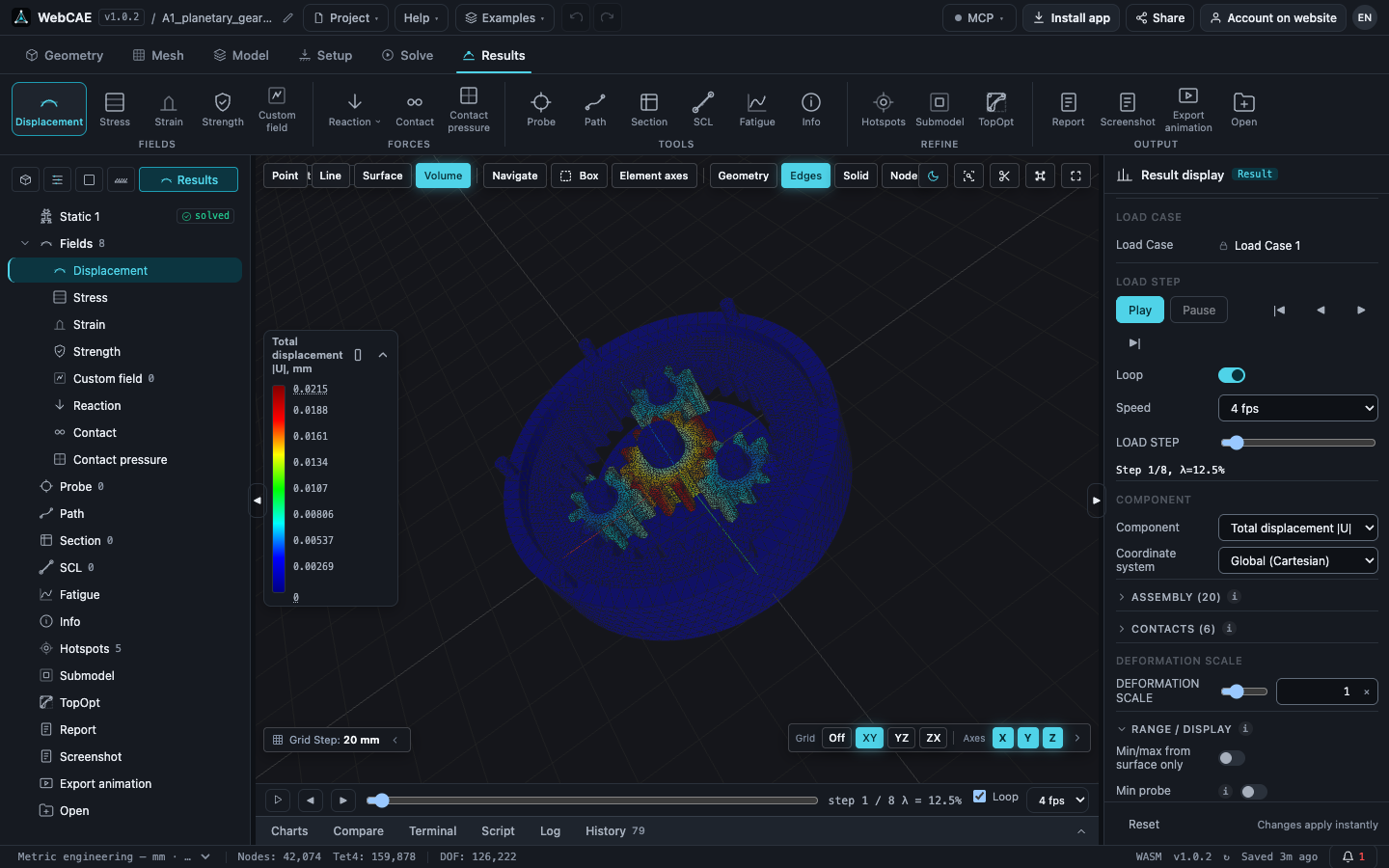
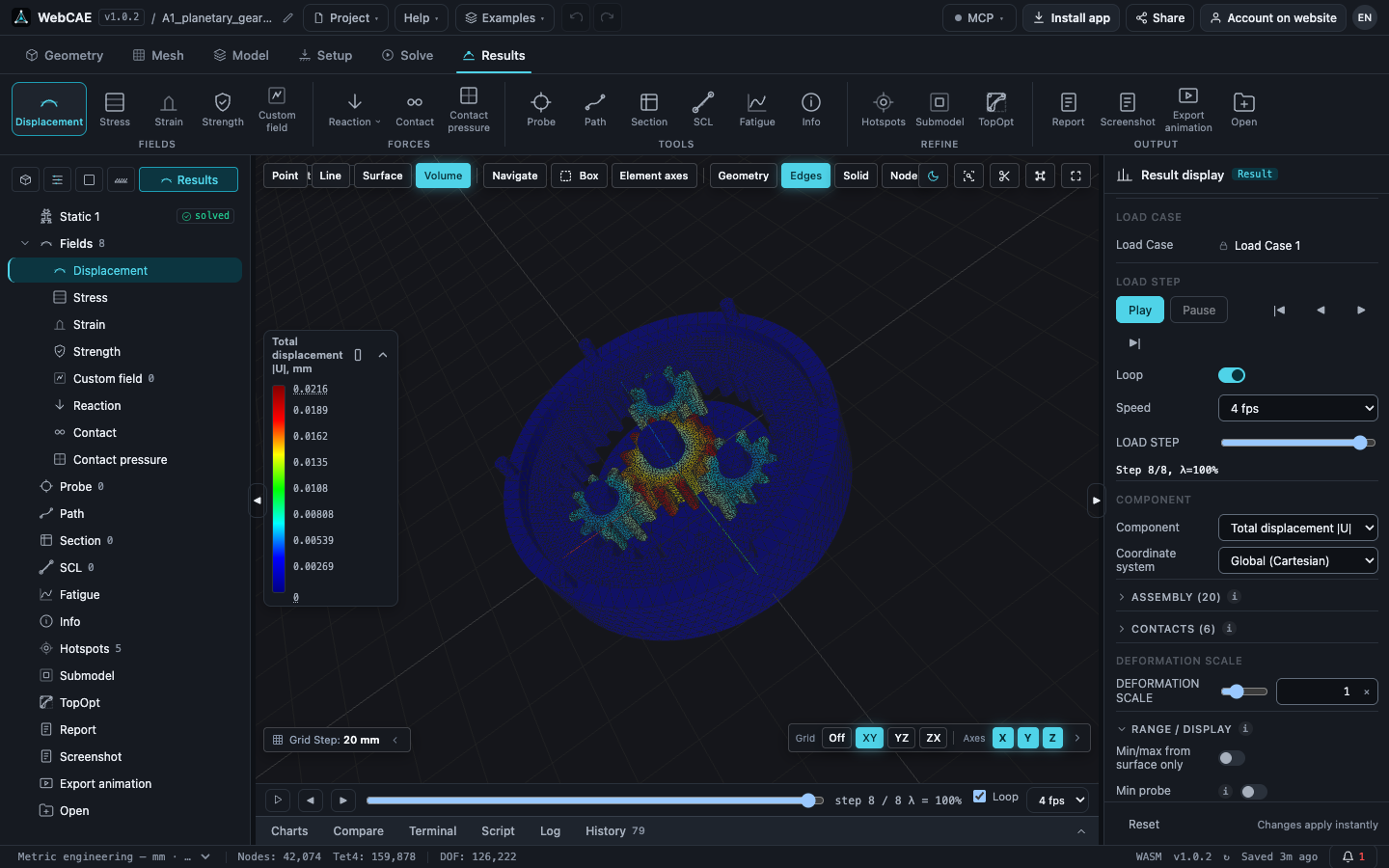
Across Steps 1–8, the carrier advances from 3.0515° to 4.5383° and the sun gear advances from 11.00° to 16.25°. Because WebCAE stores rigidDisplacement separately from elastic displacement, engineers can inspect true 0.021–0.023 mm tooth bending deflection in Displacement view at every orbital pose without rigid rotation swamping the color scale:
Download the Pre-Solved .wce Project & Inspect in WebCAE
Every step snapshot, field (Displacement, Von Mises, Contact Pressure), mesh, and boundary condition is bundled inside the project file below:
- Download solved 8-step project: `A1_planetary_gearbox_20part.wce` (10.3 MB)
- Download canonical WebCAE DSL script: `A1_planetary_gearbox_20part.dsl` (3.7 KB)
Open app.webcae.com, drag and drop A1_planetary_gearbox_20part.wce, and use the step selector to scrub smoothly from Step 1 through Step 8 across Von Mises, Contact Pressure, and Displacement. Questions or complex contact assemblies of your own? Share them in Discord or Telegram.