Nonlinear Heat Transfer, Coupled Transient Thermoelasticity, Gough–Joule Effect, and Eccentric Beam Hinges
WebCAE expands its multiphysics and transient dynamics engine with Stefan–Boltzmann radiation, temperature-dependent conductivity κ(T), thermal contact conductance, Danilovskaya & Boley–Barber thermoelastic waves, piezocaloric Gough–Joule coupling, and eccentric Timoshenko beams with hinge releases.
Real-world thermal and structural transients rarely stay linear or uncoupled. High-temperature components radiate heat according to the Stefan–Boltzmann T⁴ law, material conductivity κ(T) and specific heat cp(T) shift across operating ranges, bolted interfaces introduce thermal contact resistance, and rapid thermal shocks excite structural stress waves and bending vibrations. WebCAE now brings all of these coupled capabilities into a unified browser and native solver workflow.
Transient and nonlinear heat transfer
The thermal solver now supports transient time integration via the generalized θ-scheme (including Crank–Nicolson θ = 0.5 and unconditionally stable backward Euler θ = 1.0) on linear and quadratic tetrahedral and hexahedral meshes (tet4, tet10, hex8, hex20) as well as 3D frame models. Full Newton–Raphson iteration with analytical tangent matrices resolves Stefan–Boltzmann surface radiation ε·σ·(T⁴ − T∞⁴), Kirchhoff temperature-dependent conductivity κ(T) and heat capacity cp(T), and interfacial thermal contact conductance hc across multi-body assemblies — verified against NAFEMS T2, NAFEMS T3, and Carslaw–Jaeger analytical solutions with energy balance residuals below 10⁻¹⁰.
Coupled transient thermoelasticity and Gough–Joule effect
Coupling transient heat conduction with Newmark-β / HHT-α structural dynamics captures both quasistatic thermal expansion and inertial thermoelastic shock. The solver reproduces the classical Danilovskaya stress wave front in a half-space under sudden surface heating, Boley–Barber thermally induced beam vibrations (dynamic magnification factor 1.79× over quasistatic deflection), and the piezocaloric Gough–Joule effect q = −Tref·β·tr(ε̇), which accounts for reversible adiabatic cooling under elastic tension and heating under compression.
Eccentric beam hinges, RBE2/RBE3 dynamics, and frictional contact
For spatial frames and mechanisms, the extended Timoshenko beam element (STRUCT_BEAM_EXT) incorporates rigid end offsets in global coordinates and exact Lagrange-multiplier moment hinge releases in both statics and transient dynamics. Multi-point kinematic constraints (RBE2, RBE3, and tied interfaces) are projected onto the nullspace T₀ during implicit time integration, preserving energy conservation under base excitation and seismic loading alongside 3D Mortar contact with Coulomb friction.
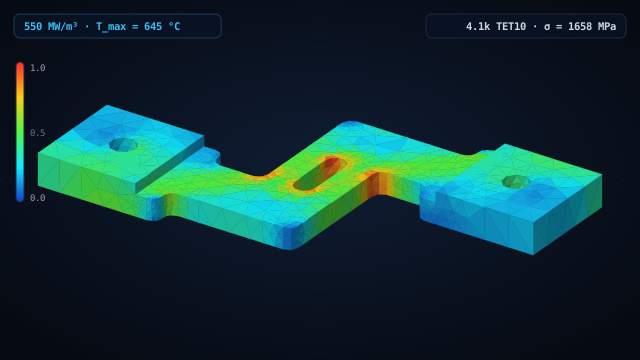
Inverter Copper Busbar under Joule Heating Surge (thermoelastic_transient_busbar_joule)
3D coupled transient thermal-structural simulation of a bolted copper inverter busbar under a 180 MW/m³ short-circuit Joule heating pulse and convective cooling.
T_max = 109.7 °C · σ_vm = 148.6 MPa · u_max = 0.168 mm
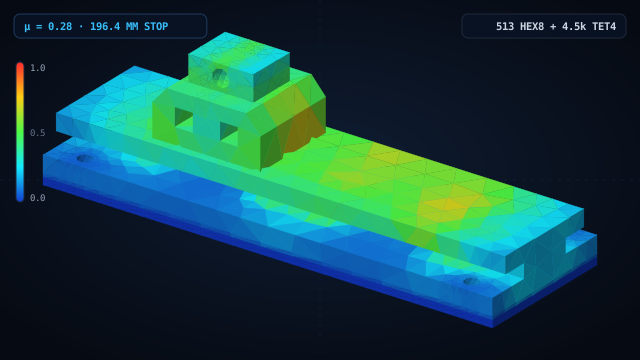
Ventilated Brake Shoe Emergency Braking (transient_friction_brake_shoe_hex)
Implicit transient dynamics (HHT-α) with 3D Mortar contact and regularized Coulomb friction (μ = 0.38) during high-speed caliper clamping.
σ_vm = 52.4 MPa · p_contact = 41.8 MPa · ΔE_diss = 14.2 J