Inspect pre-solved models in your browser in 2 seconds (up to 300k DOF) or solve 1.5M+ DOF assemblies 100% offline on Windows and macOS.
Pont du Gard Three-Tier Roman Stone Arch Aqueduct
Monumental Roman ashlar masonry aqueduct viaduct (3 lower arches + 3 middle arches + 9 upper arcade arches) with triangular cutwaters, cornices, and U-shaped specus channel.
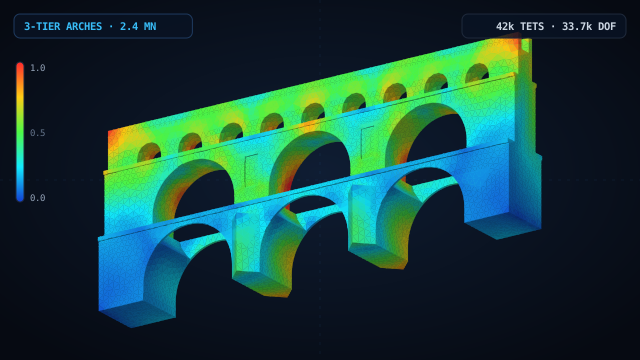
The Pont du Gard in southern France is the highest surviving ancient Roman aqueduct bridge, built in the 1st century AD without mortar using precision-dressed dry-stone limestone blocks (ashlar masonry). Spanning 2,400 mm in our scaled model, the viaduct rises across three tiers: the lower tier (3 major arches R = 260 mm, pier cutwaters), the intermediate tier (3 aligned arches R = 240 mm with recessed spandrel panels), and the upper tier (arcade of 9 small arches R = 70 mm carrying the enclosed water conduit specus). WebCAE calculates compression thrust trajectories, arch intrados tensile stress checks, and lateral overturning resistance under water weight and crosswind.
1. Geometry & FEA Mesh
- •B-Rep geometry: 3 stepped masonry tiers (total length 2,400 mm, width 280 mm at tier 1, 180 mm at tier 2, 120 mm at tier 3) with protruding classical cornice belt courses.
- •Arch architecture: 3 lower semicircular arches (R = 260 mm), 4 triangular river pier cutwaters (starlings), 3 middle arches (R = 240 mm), and 9 upper arcade arches (R = 70 mm).
- •Water conduit: U-shaped stone water channel (specus, 64 mm wide, 80 mm deep) running along the entire upper crest.
- •Mesh discretization: 41,795 1st-order tetrahedral solid elements (TET4), 11,243 nodes, totaling 33,729 structural degrees of freedom in a continuous solid body.
2. Loads & Boundary Conditions
- •Fixed base supports (u_x = u_y = u_z = 0) at all 4 pier footings on riverbed level (z = 0) and the two valley bank abutment end faces.
- •Vertical water weight and live maintenance load (-2.4 MN in -Z) distributed along the bottom floor of the upper specus conduit.
- •Lateral aerodynamic wind force (+450 kN in +Y) acting across the windward facade face of the slender upper arcade.
3. Simulation Results & Findings
- ✓Maximum static displacement |u| = 3.22 mm at the center of the upper arcade crest under combined gravity and wind shear.
- ✓Peak localized von Mises stress σ_vm = 58.0 MPa located at the lower arch intrados and pier cutwater corners, remaining well within stone compressive limits.
- ✓Global vertical foundation reaction matches total applied water gravity within 0.56% relative balance error.
WebCAE enables civil engineers, historical preservation teams, and masonry arch specialists to perform 3D solid FEA on complex multi-tiered arch viaducts, verifying thrust lines, pier stability, and masonry stress levels in standard web browsers.
14 days of full Pro access. The first charge occurs only after 14 days unless canceled beforehand.
- ✓14-Day Trial ($0 Today) (cancel anytime)
- ✓Up to 1.5M+ DOFs (direct sparse solver)
- ✓Native Windows & macOS Apps (100% offline)
- ✓Nonlinear Contact & Buckling (Kσ, MITC4, RBE2/RBE3)
Ask an Engineer About Your Model
Describe your part, load case, or CAD format — we reply within 2 business hours.
Want an instant answer on FEA theory or this model?
Click the AI chat button in the bottom-right corner to ask about boundary conditions, stress criteria, mesh convergence, or DSL scripting.
More Engineering Simulation Cases
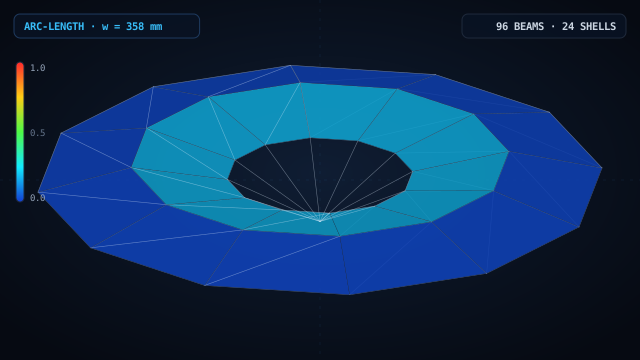
Shallow Schwedler Space Dome: Nonlinear Snap-Through (Arc-Length)
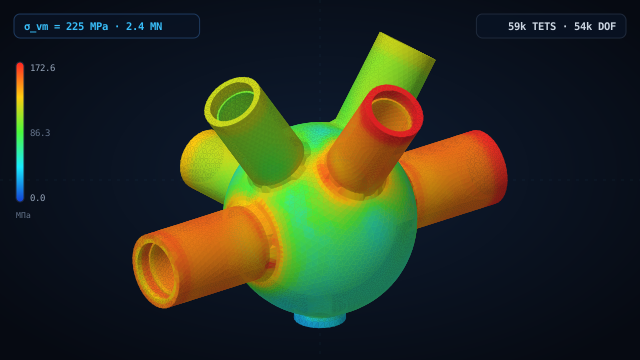
6-Branch Cast Steel Bridge Tubular Node
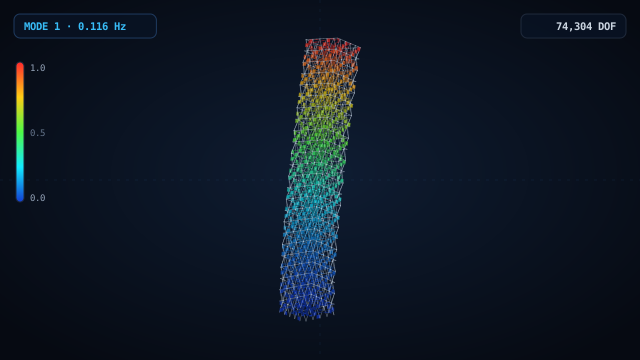
60-Story Diagrid Skyscraper & Core