Inspect pre-solved models in your browser in 2 seconds (up to 300k DOF) or solve 1.5M+ DOF assemblies 100% offline on Windows and macOS.
5-Blade Marine Propeller Ø4.2 m
Hydrodynamic thrust cantilever blade deflection and blade root stress verification for commercial vessel propulsion.
Marine propeller blades endure severe hydrodynamic pressure distributions resulting from the ship's non-uniform wake field and steady axial bollard-pull thrust. Bending moments concentrated at the blade root fillets can induce cyclic fatigue and acoustic vibration if blade thicknesses are excessively reduced for hydrodynamic efficiency. This FEA simulation validates blade tip deflection and verifies that root bending stresses comply with classification society (DNV / RS) allowable stress standards under 400 kN steady thrust.
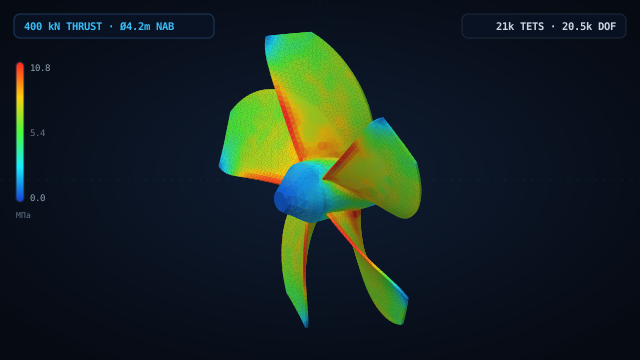
1. Geometry & FEA Mesh
- •Cast nickel-aluminum bronze CuAl10Fe5Ni5 / БрАЖНМц (E = 118 GPa, ν = 0.33, yield strength 250 MPa).
- •Monobloc Ø4.2 m propeller geometry featuring 5 skewed and raked blades with variable pitch NACA sections.
- •Central conical hub with 1:10 taper bore and standardized drive shaft drive keyway.
- •Conformal 3D tetrahedral mesh of 21,200 elements and 20,500 active degrees of freedom.
2. Loads & Boundary Conditions
- •Rigid cylindrical constraint applied to the tapered internal shaft seating surface of the central propeller hub.
- •Distributed forward hydrodynamic face pressure producing 400 kN total axial thrust applied to the pressure faces of all 5 blades.
- •Centrifugal body force distribution corresponding to service shaft speed of 120 rpm.
3. Simulation Results & Findings
- ✓Peak von Mises stress σ_vm = 14.9 MPa located at the suction-side root blend radius (0.2R section) of the blades.
- ✓Maximum displacement magnitude |u| = 1.877 mm at the outer tip of the propeller blade leading edge.
- ✓Safety factor SF = 16.7 against yield, guaranteeing compliance with DNV and Russian Maritime Register rules.
Shipyards and naval architecture bureaus verify propeller blade hydroelastic deflection in WebCAE directly in the web browser without installing specialized CAD/CAE bundles. Instant cloud calculations streamline class approval submissions and prevent expensive cavitation-induced refits.
14 days of full Pro access. The first charge occurs only after 14 days unless canceled beforehand.
- ✓14-Day Trial ($0 Today) (cancel anytime)
- ✓Up to 1.5M+ DOFs (direct sparse solver)
- ✓Native Windows & macOS Apps (100% offline)
- ✓Nonlinear Contact & Buckling (Kσ, MITC4, RBE2/RBE3)
Ask an Engineer About Your Model
Describe your part, load case, or CAD format — we reply within 2 business hours.
Want an instant answer on FEA theory or this model?
Click the AI chat button in the bottom-right corner to ask about boundary conditions, stress criteria, mesh convergence, or DSL scripting.