Tet4 vs Tet10 vs Hex8: Accuracy and Solve Time on the Same Part
10 native WebCAE runs on the exact same 200 × 20 × 20 mm cantilever: at ~16k–20k DOFs, Tet10 hits 0.810% deflection and 0.047% P2 stress error vs Tet4's 4.671% and Hex8's 2.019% — while coarse Tet4 locks at 18.709% error.
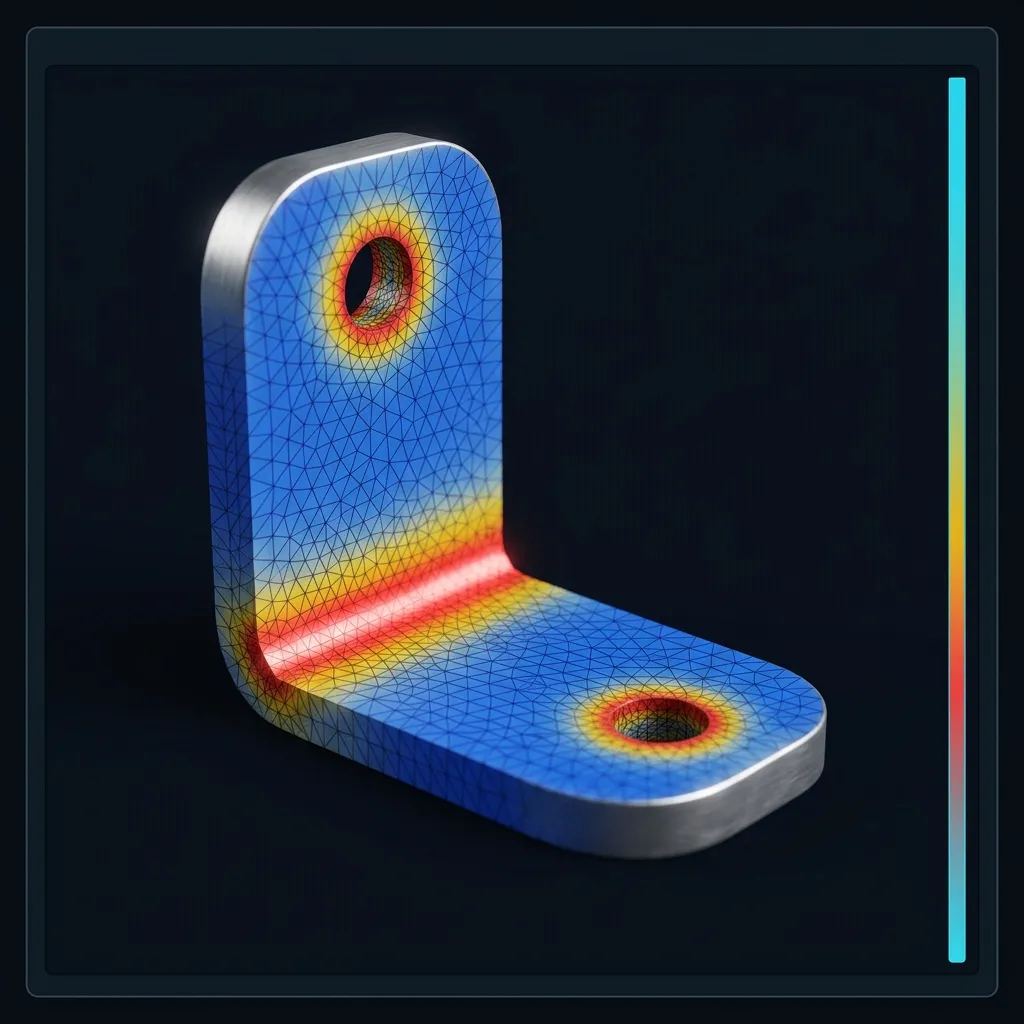
Why Element Choice Matters More Than Mesh Density Alone
Choosing between 4-node linear tetrahedra (Tet4), 10-node quadratic tetrahedra (Tet10), and 8-node trilinear hexahedra (Hex8) changes bending accuracy far more than simply dragging the global element-size slider finer. A coarse linear tetrahedral mesh can look dense enough on screen and still underpredict beam deflection by nearly 19%, while a quadratic mesh with a fraction of the elements hits sub-percent accuracy in milliseconds.
Instead of repeating rules of thumb, we ran a controlled benchmark in WebCAE's native solver (webcae_solve) on the exact same solid part across 10 mesh configurations — matching degrees of freedom (~16k–20k DOFs), comparing a coarse ~3k DOF budget, and sweeping from 750 to 58,047 free DOFs against closed-form Euler–Bernoulli and Timoshenko beam theory.
Geometry, Inputs & Analytical Reference
All 10 runs use the identical prismatic cantilever solid with zero geometry simplifications:
- Geometry: Rectangular box cantilever
200 × 20 × 20 mm(span-to-depth slenderness ratioL/H = 10). - Material: Structural Steel — Young's modulus
E = 200 GPa(200,000,000,000 Pa), Poisson's ratioν = 0.3. - Boundary condition: Clamped support on the
x = 0 mmend face (all 3 translational DOFs fixed:u_x = u_y = u_z = 0). - Applied load: Vertical tip shear force
Fz = -1,000 Ndistributed consistently over thex = 200 mmtip face (20 × 20 mm).
For this geometry and load (I = b·H³ / 12 = 13,333.3 mm⁴, shear factor κ = 5/6), classical closed-form mechanics gives exact verification targets:
- Euler–Bernoulli tip deflection:
1.0000 mm - Timoshenko tip deflection (including transverse shear):
1.0078 mm - Nominal bending stress (
σ_xx = M·c / I):150.0 MPaat the root (x = 0 mm),135.0 MPaatx = 20 mm(one beam depth away from the clamped boundary), and75.0 MPaat mid-span (x = 100 mm).
Solver & Mesh Setup
Every simulation ran through WebCAE's native C++ structural solver (webcae_solve) with two mesh generators and consistent stress-recovery reporting:
- Tetrahedral meshes (
Tet4andTet10): Generated with WebCAE's nativenetgen_tetmesh.Tet4uses 4 corner nodes (constant strain per element), whereasTet10adds 6 midside edge nodes per tetrahedron for a quadratic displacement field. - Hexahedral meshes (
Hex8): Generated with WebCAE's structured OCCT + TS sweep path (tryHexRouteBeforeTet) using an 8-node trilinear brick with selectiveB-barvolumetric projection to prevent volumetric locking. - Stress evaluation transparency: In raw native solver output,
solve_structural_model_nativeevaluatessolidHexStress,solidTetStress, andsolidTet10Stressat element centroids and averages them to nodes. ForHex8(h = 2.5 mm), element centroids lie0.5·h = 1.25 mmbeneath the outer surface (z = ±8.75 mminstead of±10.0 mm), where nominal bending stress is65.6 MParather than75.0 MPa. In WebCAE's interactive post-processor,Tet10uses quadraticP2nodal stress recovery (computeMixedTetNodalStress), eliminating that centroid-depth bias. Both raw centroid andP2nodal numbers are reported below.
Head-to-Head at Comparable ~16k–20k DOFs
First, we match computational budget in the 15.5k–19.8k free-DOF range: Tet4 at h = 2.4 mm, Hex8 at h = 2.5 mm, and Tet10 at h = 5.0 mm.
| Metric | Tet4 (h = 2.4 mm) | Hex8 (h = 2.5 mm) | Tet10 (h = 5.0 mm) | Analytical Reference |
|---|---|---|---|---|
| Elements | 28,862 | 4,096 | 3,122 | — |
| Nodes | 6,716 | 5,265 | 5,941 | — |
| Free DOFs (Total DOFs) | 19,839 (20,148) | 15,552 (15,795) | 17,556 (17,823) | — |
| Mesh time | 1,061 ms | 55 ms | 194 ms | — |
| Solve time | 172 ms | 130 ms | 213 ms | — |
| Tip mean deflection | 0.9607 mm | 0.9875 mm | 0.9996 mm | 1.0078 mm (Timoshenko) |
| Tip error vs Timoshenko | 4.671% | 2.019% | 0.810% (0.036% vs EB) | 0% |
Mid-span σ_xx (x = 100 mm) | 68.26 MPa (centroid) | 64.84 MPa (centroid) | 75.04 MPa (P2 nodal) | 75.0 MPa (74.93 MPa at Tet4 probe) |
Mid-span σ_xx error | 8.903% | 13.548% (depth 0.5·h) | 0.047% (P2 nodal) | 0% |
x = 20 mm σ_xx (error) | 124.46 MPa (7.815%) | 118.00 MPa (13.193%) | 134.53 MPa (0.348%) | 135.0 MPa |
Root σ_xx (x = 0 mm) | 186.76 MPa | 138.73 MPa | 200.65 MPa (P2) | 150.0 MPa nominal (+3D clamp effect) |
Even with 9.2× more elements and more DOFs (19,839 vs 17,556), Tet4 has nearly 6× larger deflection error than Tet10 (4.671% vs 0.810% against Timoshenko) and takes over 5× longer to mesh (1,061 ms vs 194 ms). Meanwhile, Tet10 recovers mid-span bending stress within 0.047% (75.04 MPa vs 75.0 MPa) and x = 20 mm bending stress within 0.348% (134.53 MPa vs 135.0 MPa). Note that right at the rigid clamp (x = 0 mm), full 3D Poisson restraint creates a genuine local stress spike above nominal 150.0 MPa (200.65 MPa in P2 Tet10, 186.76 MPa in Tet4).
Coarse-Mesh Budget (~3k DOFs) & Full Sweep
What happens when you drop to a fast ~3k DOF preview mesh, or refine across a full mesh-convergence ladder?
Coarse-Mesh Comparison at ~3k Free DOFs (h = 5.0 mm)
| Metric | Tet4 (h = 5.0 mm) | Hex8 (h = 5.0 mm) | Tet10 (h = 16.0 mm) |
|---|---|---|---|
| Elements | 3,122 | 640 | 90 |
| Nodes | 994 | 1,025 | 259 |
| Free DOFs (Total DOFs) | 2,901 (2,982) | 3,000 (3,075) | 750 (777) |
| Mesh / Solve time | 196 ms / 18 ms | 43 ms / 18 ms | 63 ms / 5 ms |
| Tip deflection | 0.8193 mm | 0.9649 mm | 0.9920 mm |
Error vs Timoshenko (1.0078 mm) | 18.709% | 4.261% | 1.572% |
Mid-span σ_xx (error) | 56.76 MPa (24.325%) | 54.36 MPa (27.521%) | 76.02 MPa (1.366%, P2) |
At h = 5.0 mm, Tet4 (2,901 free DOFs) loses 18.709% of its deflection due to severe shear locking — reporting 0.8193 mm in 18 ms. For the exact same 18 ms solve time and 3,000 free DOFs, Hex8 drops deflection error more than 4× to 4.261% (0.9649 mm). Even more striking: an ultra-coarse Tet10 mesh with only 90 elements and 750 free DOFs (h = 16.0 mm) solves in 5 ms and already hits 0.9920 mm (1.572% error vs Timoshenko, 0.805% vs Euler–Bernoulli) with 76.02 MPa mid-span P2 stress (1.366% error).
Complete 10-Run Sweep Summary
| Run | Elements | Free DOFs | Mesh / Solve | Tip Deflection | Deflection Error (vs Timoshenko) | Mid-Span σ_xx (Method) |
|---|---|---|---|---|---|---|
Tet4 h = 5.0 mm | 3,122 | 2,901 | 196 / 18 ms | 0.8193 mm | 18.709% | 56.76 MPa (centroid) |
Tet4 h = 2.4 mm | 28,862 | 19,839 | 1,061 / 172 ms | 0.9607 mm | 4.671% | 68.26 MPa (centroid) |
Tet4 h = 1.8 mm | 45,884 | 32,181 | 1,753 / 334 ms | 0.9696 mm | 3.792% | 70.75 MPa (centroid) |
Hex8 h = 5.0 mm | 640 | 3,000 | 43 / 18 ms | 0.9649 mm | 4.261% | 54.36 MPa (centroid) |
Hex8 h = 2.5 mm | 4,096 | 15,552 | 55 / 130 ms | 0.9875 mm | 2.019% | 64.84 MPa (centroid) |
Hex8 h = 2.0 mm | 6,400 | 23,232 | 64 / 245 ms | 0.9884 mm | 1.926% | 66.76 MPa (centroid) |
Tet10 h = 16.0 mm | 90 | 750 | 63 / 5 ms | 0.9920 mm | 1.572% | 76.02 MPa (P2 nodal) |
Tet10 h = 10.0 mm | 1,512 | 7,182 | 335 / 93 ms | 0.9970 mm | 1.076% | 75.06 MPa (P2 nodal) |
Tet10 h = 5.0 mm | 3,122 | 17,556 | 194 / 213 ms | 0.9996 mm | 0.810% | 75.04 MPa (P2 nodal) |
Tet10 h = 3.5 mm | 12,492 | 58,047 | 521 / 1,055 ms | 1.0003 mm | 0.749% | 75.04 MPa (P2 nodal) |
Notice the takeaway at the bottom of the Tet4 ladder: even after pushing Tet4 to 45,884 elements and 32,181 free DOFs (1,753 ms mesh + 334 ms solve), its 3.792% deflection error is still 2.4× worse than Tet10 with 90 elements and 750 free DOFs (5 ms solve).
Why Each Element Family Behaves This Way
- Why Tet4 locks in bending: A 4-node linear tetrahedron is a constant-strain simplex — its shape functions only produce spatially uniform strain inside each element. Bending creates a linear strain gradient from tension on top to compression on bottom. Because
Tet4cannot represent pure linear bending without generating spurious transverse shear strain, a large portion of external work gets absorbed into artificial shear stiffness. CoarseTet4meshes become artificially stiff (18.709%under-deflection at ~3k DOFs), and thin walls with only 1–2 elements through thickness suffer the worst error. - Why Tet10 excels on arbitrary 3D CAD / STEP: A 10-node quadratic tetrahedron supports linearly varying strain and stress fields inside every element, eliminating shear locking completely. Its midside nodes also project onto curved B-Rep fillets, bores, and cylinders, avoiding faceted geometry errors. Combined with WebCAE's
P2nodal stress recovery,Tet10converges rapidly (0.047%–0.085%mid-span stress error from7.2kDOFs onward) on complex STEP parts where swept hex meshing is impossible. - Why Hex8 performs well on swept and decomposed solids: Aligned trilinear bricks coupled with selective
B-barvolumetric projection represent bending kinematics much more cleanly along aligned axes than unstructuredTet4simplices — giving 2×–4× lower coarse-mesh deflection error per DOF (4.261%vs18.709%at ~3k DOFs) and blazing-fast43–64 msswept meshing. Its main practical caveats are geometry prep (arbitrary multi-feature CAD must be decomposed into sweepable blocks) and surface stress sampling when evaluating only at0.5·hinterior centroids rather than extrapolating to outer nodes.
Practical Selection Rule: When to Pick Each Element
- Pick Tet10 (default for 3D CAD / STEP): Whenever the part comes from real CAD (fillets, ribs, holes, castings, assemblies), carries bending loads, or needs accurate peak stresses at notches and bolted joints. Even moderate mesh sizes (
h = 5–10 mmhere) deliver sub-1% deflection and< 0.1%nominal bending stress accuracy. - Pick Hex8 (for sweepable blocks and fast parametric sweeps): Whenever the solid is prismatic, axisymmetric, or decomposed into clean sweepable regions — especially if you want ultra-fast
~50 msmeshing or structured meshes for contact interfaces, with sufficient through-thickness layers (≥ 8elements across depth here gives2.019%tip error; note0.5·hcentroid depth on outer-skin stress). - Pick Tet4 (only for rapid geometry checks, thermal conduction, or non-bending bulk checks):
Tet4is useful for quick initial topology checks or pure axial/thermal fields, or whenhis heavily refined (≥ 4–6elements through thin bending walls). Never trust a coarseTet4mesh on bending-dominated structures.
Explore Docs, Verification & Run in Browser
- Inspect formulations and integration rules in the WebCAE Element Library Docs.
- Check the benchmark setup on Cantilever Beam (Timoshenko) Verification.
- Read how element order pairs with h-refinement in the FEA Mesh Convergence Guide.
- Launch Online FEA or upload your own geometry via CAD to FEA (STEP/IGES).
- Try WebCAE in your browser — mesh the same geometry with
Tet4,Tet10, orHex8and compare deflections and solve times directly.