Inspect pre-solved models in your browser in 2 seconds (up to 300k DOF) or solve 1.5M+ DOF assemblies 100% offline on Windows and macOS.
LRE Turbopump Axial Helical Inducer & 4-Vane Deswirl Stator Stage (CFD)
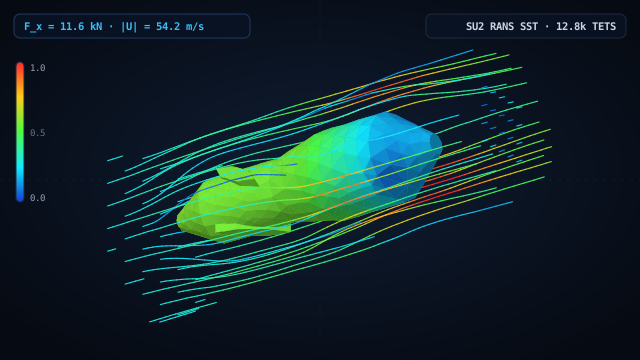
3D turbulent hydrodynamics (RANS k-ω SST, RP-1 kerosene at U_in = 14.0 m/s, m = 252.4 kg/s) of a two-row rocket turbopump booster stage comprising a conical-hub 3-bladed helical inducer (pitch 34°) and a 4-vane counter-pitched deswirl stator (−18°).
High-pressure liquid rocket engine turbopumps (such as the RD-170/RD-180 and LE-7A booster pumps) place an axial helical inducer stage upstream of the main centrifugal impeller to pressurize propellant at low inlet pressure and prevent cavitation breakdown, followed by stationary deswirl stator vanes that convert tangential swirl back into axial flow. This 3D CFD model represents a Ø170 mm annular turbopump duct (420 mm length) housing a streamlined central hub that ramps radially from R_hub1 = 30 mm across the 3-bladed pitched inducer row (chord 68 mm, blade pitch +34°, 9 mm tip clearance) to R_hub2 = 42 mm across the 4-vane counter-pitched stator row (chord 52 mm, vane pitch −18°, 7 mm tip clearance). Operating on RP-1 kerosene (ρ = 800 kg/m³, μ = 0.0016 Pa·s) at U_in = 14.0 m/s (mass flow rate 252.35 kg/s), the native SU2_CFD (k-ω SST) solution resolves meridional + blade-to-blade acceleration up to |U|_max = 54.21 m/s (3.87× U_in), suction-side low-pressure pockets (−305.0 kPa) critical for NPSH cavitation screening, an axial hydrodynamic load of F_X = 11.58 kN, a stage pressure differential of Δp = 2.194 MPa, and tip-leakage vortex cores (Q_max = 4.87×10⁵ s⁻²).
1. Geometry & FEA Mesh
- •Single connected B-Rep fluid volume (31 topological faces, V = 8.55×10⁶ mm³): cylindrical casing X ∈ [−130, 290] mm, radius R_casing = 85 mm (Ø170 mm).
- •Streamlined variable-radius hub: nose cone (X ∈ [−75, −35] mm), inducer hub cylinder R = 30 mm (X ∈ [−35, 45] mm), conical meridional ramp R = 30 → 42 mm (X ∈ [45, 95] mm), stator hub cylinder R = 42 mm (X ∈ [95, 165] mm), and tail cone (X ∈ [165, 210] mm).
- •Row 1 (Inducer): 3 hydrofoil blades (chord 68 mm, thickness 15 mm, pitch +34°, R = 22..76 mm); Row 2 (Deswirl Stator): 4 hydrofoil vanes (chord 52 mm, thickness 13 mm, pitch −18°, R = 34..78 mm).
- •Unstructured 3D tetrahedral mesh: 12,807 tetrahedra and 3,101 nodes (volume error 0.27%); fluid: RP-1 kerosene (ρ = 800 kg/m³).
2. Loads & Boundary Conditions
- •Upstream casing inlet face at X = −130 mm (surface number 3): uniform RP-1 kerosene velocity U_in = 14.0 m/s (mass flow 252.35 kg/s).
- •Downstream casing outlet face at X = +290 mm (surface number 2): static gauge pressure p_out = 0 Pa.
- •Outer cylindrical casing shroud at R = 85 mm (surface number 1): slip / symmetry boundary condition.
- •All 28 internal surfaces of the hub, 3 inducer blades, and 4 stator vanes (surfaces 4–31): viscous no-slip wall with active force integration (monitor=on).
3. Simulation Results & Findings
- ✓Meridional hub contraction and blade cascade blockage accelerate the kerosene flow from 14.0 m/s up to |U|_max = 54.21 m/s (3.87× inlet velocity).
- ✓Total axial hydrodynamic force acting on the inducer + stator assembly is F_X = 11,579.2 N (11.58 kN, C_D = 22.25) with a net lateral side-force residual reduced by the 4-vane deswirl stator to F_L = 643.1 N.
- ✓Stage static pressure differential is Δp = 2.194 MPa (stagnation peak +2.327 MPa, blade suction minimum −305.0 kPa), while blade-tip and trailing-edge vortices reach |ω|_max = 1,698.1 s⁻¹ and Q_max = 4.87×10⁵ s⁻² (mass balance error 0.36%).
Turbomachinery engineers use WebCAE CFD to screen inducer blade pitch angles, meridional hub contours, suction-side cavitation margins, and axial thrust loads on rocket turbopump bearings.
14 days of full Pro access. The first charge occurs only after 14 days unless canceled beforehand.
- ✓14-Day Trial ($0 Today) (cancel anytime)
- ✓Up to 1.5M+ DOFs (direct sparse solver)
- ✓Native Windows & macOS Apps (100% offline)
- ✓Nonlinear Contact & Buckling (Kσ, MITC4, RBE2/RBE3)
Ask an Engineer About Your Model
Describe your part, load case, or CAD format — we reply within 2 business hours.
Want an instant answer on FEA theory or this model?
Click the AI chat button in the bottom-right corner to ask about boundary conditions, stress criteria, mesh convergence, or DSL scripting.
More Engineering Simulation Cases
Aerospace Clevis, Lug & Shear Pin Joint
Large-Deflection Flexible UAV Wing under Follower Aerodynamic Pressure
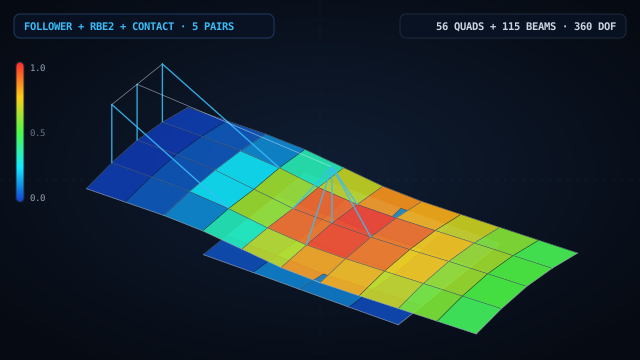
Wing Box Panel with Actuator RBE2 Bracket, Follower Aero Pressure & Stop Contact